
CALL TO ARTISTS
Death as Culture: In-Person Artist Residencies in New Orleans
The Residency is one week long and is offered in a choice of two sessions:
Week 1: Tuesday, 27 October to Saturday, 31 October 2026
OR
Week 2: Sunday, 1 November to Thursday, 5 November 2026
Pre-Residency Virtual Zooms: Wednesday, 21 October and Thursday, 22 October, 7-9PM EDT
Early deadline to apply: Saturday, 3 October 2026
Final deadline to apply: Saturday, 10 October 2026
THESIS
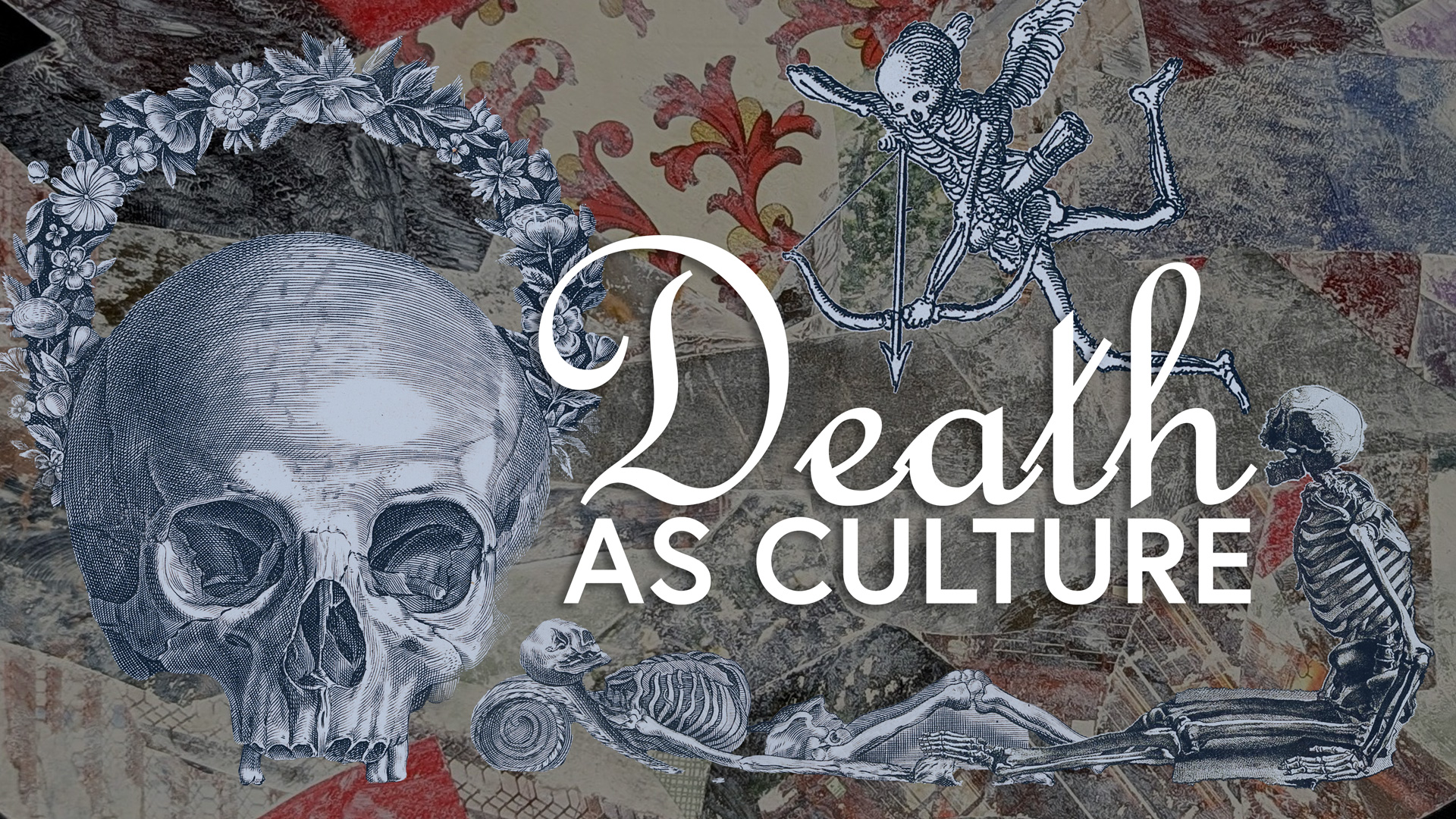
The inevitability, finality, and universality of Death as a human experience makes its presence in folklore ubiquitous and not surprising. Every culture has a story about death, a way to explain the unexplainable. From such stories, a rich pattern of rituals and philosophies shape our understanding and experience of Death and life that leads up to it. Ideas about the origin of death; where one dies; how the body is treated; what happens after life; how grief and loss is understood; the liminal space between life and death; and how the dead are remembered shape culture. The Stoic phrase, memento mori, a daily practice of remembering that one must die, has inspired craftspeople and artists since classical antiquity. Humanity’s awareness of its mortality shapes religion. Philosophers like Arthur Schopenhauer (German, 1788-1860) argued that without death philosophy would not be possible. Throughout history, ideas about death have informed the folklore of communities. In Death as Culture, we are interested in how collage artists make art about death, how they document and share the folklore, and how these artworks can impact communities.
THE RESIDENCY
Building on an earlier exploration of Joy & Grief, Kolaj Institute will investigate Death as Culture through a series of In-Person and Virtual Collage Artist Residencies during which we will research how death is expressed in a diverse array of cultures. We will consider the death-related folklore that speaks to the origin of death, the afterlife, and those in the liminal spaces between life and death such as ghosts and spirits.
Artists attending the residency from Tuesday, 27 October to Saturday, 31 October 2026 will experience New Orleans as it celebrates Halloween. Artists attending the residency from Sunday, 1 November to Thursday, 5 November 2026 will kick off their residency by observing Fet Gede celebrations of Haitian culture and ancestry on Day of the Dead at the New Orleans Healing Center. Each group will visit St. Roch Cemetery to witness first hand cultural expressions around death.
Collage Artist Residencies are designed for artists who want to expand their established practice to better diffuse their artwork into the ecosystem of art while fostering engagement and impact. Working in community with other artists, participants will consider how research informs process and making and how to prepare and present artwork to art professionals like curators, gallerists, art educators, and exhibition managers. Through interactive sessions, collections research, and collaborative collage making, artists will explore their process and practice; make a presentation about their work; receive supportive, critical, curatorial feedback about their ideas; and discuss how their artwork speaks to contemporary issues and concerns. Residencies will discuss issues of appropriation, copyright, and fair use and explore how the artist’s choice and understanding of material shapes the stories of the artwork. Artists will complete the residencies with a new perspective on their art practice.
OUTPUTS
The artwork made during and after the residency will be considered for a January 2027 exhibition at Kolaj Institute Gallery in New Orleans and an October 2027 exhibition at the New Orleans Healing Center in conjunction with Fet Gede Celebrations. Artwork and writing will be considered for Folklore Collage Society, a printed journal dedicated to artwork and artists who activate, transmit, and celebrate folklore as a form of cultural expression and a strategy for community resilience.
WHO IS THIS FOR?
Collage Artist Residencies are intended for self-motivated artists, at any stage in their career, who want to develop their practice by exploring a topic or working method and collaborating with others to produce a final product. This particular residency will be of interest to those artists working in social and political collage, or those who are interested in doing so. Residencies are open to any artist over the age of 21 from anywhere in the world.
COST
The cost of the residency is $750 USD per artist. Kolaj Institute has a limited number of grants available to offset the cost of the residency for those in need. These grants are possible through the generous support of our donors.
Travel to and from New Orleans, accommodations in New Orleans, and all meals are the responsibility of the artist. Financial aid is not available to offset the expense of travel, accommodation, or meals.
HOW TO APPLY
Submit your application HERE.
RESIDENCY LOGISTICS
Death as Culture will have two Virtual Sessions (21 & 22 October 2026, 7-9PM EDT) before convening at Kolaj Institute Gallery in New Orleans, 27-31 October or 1-5 November 2026, when the gallery will be converted into a working studio. Artists will have 24-hour access to the space during the Residency. Artists and faculty will come together as a group for approximately two hours each day for presentations and discussion. The schedule of site visits and other activities will be shared with invited artists.
Artists will have full access to the Kolaj Institute’s Material Library which stocks general collage-making materials such as cutting mats, scissors, a variety of glues, substrates, and books and magazines. If an artist wishes to use specific materials they may be shipped in advance to New Orleans.
APPLICATION PROCESS
The submission process asks applicants for:
• Contact information
• Artist Bio (50-250 words)
• Statement of Artist Practice (50-300 words)
• 5-7 images of artwork
• Statement of expectations
• Asks questions about your work and needs
QUESTIONS
If you have questions, send an email.
ABOUT RIC KASINI KADOUR
Ric Kasini Kadour, a 2020-2021 Andy Warhol Foundation for the Visual Arts Curatorial Fellow, is a writer, artist, publisher, cultural worker, and the director of Kolaj Institute. His curation work includes exhibitions in Louisiana, New Mexico, Quebec, Scotland, Tennessee, Wisconsin, and Vermont. Kadour is the editor and publisher of Kolaj Magazine, as well as the editor of the Kolaj Institute journals, PoetryXCollage and Folklore Collage Society. He has written for a number of galleries and his writing has appeared in publications including Hyperallergic, OEI, Art New England (where he was the former Vermont editor), and Wissenschaft & Frieden. Kadour maintains an active art practice and his photography, collage, film and sculpture have been exhibited in and are part of private collections in Australia, Europe and North America. In January-February 2020, he was artist-in-residence at MERZ Gallery in Sanquhar, Scotland. He holds a BA in Comparative Religion from the University of Vermont. Kadour splits his time between Montreal and New Orleans. Learn more at www.rickasinikadour.com.