
CALL TO ARTISTS
The River Goes Up & Down: Virtual Collage Artist Lab
A four-week, virtual/online Artist Lab with Kolaj Institute in November & December 2026
Early Deadline to apply: Sunday, 11 October 2026
Final Deadline to apply: Sunday, 25 October 2026
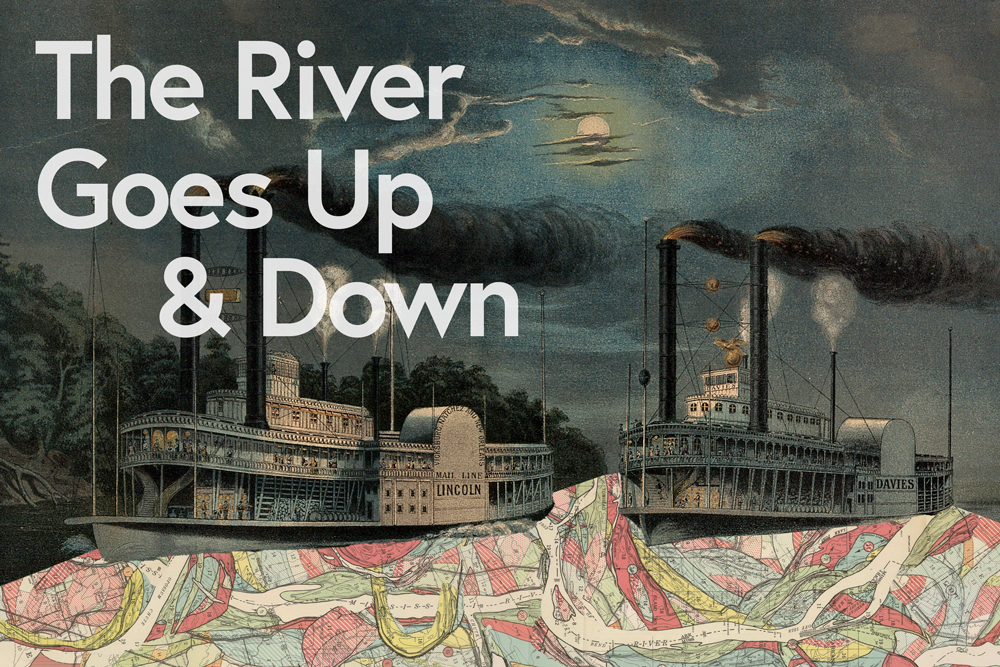
The River is not one thing, in one place, at one time. At any place along The River, there is an Up River and a Down River. The River itself is constantly going Up and Down. These observations seem obvious but they have profound implications for how we see the River as Culture: Who is coming to us? Who is going away? What do we send up or down the river? What happens when the River goes up or down too much? As Kolaj Institute continues its year-long exploration of the River as Culture, during this Virtual Collage Artist Lab, artists will research and make art about the Ups and Downs of the River and consider such wide-ranging events as 19th-century steamboat racing and the Great Flood of 1927.
“The River Bends and So Must We” is a project of Kolaj Institute that reflects on the Mississippi River as a dynamic force of culture. In 2026 and 2027, we will bring together artists from the International Collage Community to make artwork that imagines and speaks to what lessons the River can teach us about our own humanity. We will consider the history of the River in New Orleans from primordial times, pre-Columbian civilization, and to the present moment. We will examine how the River is an economic force, a tool of power, a natural wonder, and source of magic. We will take up Maya Angelou’s (1928–2014) invitation in her poem, “On the Pulse of Morning”, and “Speak to humankind today. Come to me, here beside the River.”
The goal of the Collage Artist Lab is to equip artists with tools and strategies for picking up the unfinished work of history and speak to contemporary civic discourse around social, economic, and environmental issues. Through interactive sessions, collections research, and collaborative collage making, artists will explore their process and practice; present a slideshow of their work; receive supportive, critical, curatorial feedback about their ideas; and discuss contemporary issues. The Lab will speak to issues of appropriation, copyright, and fair use and explore how the artist’s choice and understanding of material shapes the narrative of the artwork. Artists will leave the Lab with a new perspective on their art practice.
Drawing from historical archives, artists will develop plans for art making. Through a series of presentations, artists will explore using archives and history; the role of artist research; develop strategies of making, exhibiting, and publishing collage art that speaks to a sense of place and history; hear about Kolaj Institute Projects and how artists can make art for books and exhibitions around photography and collage, architecture, trash as materials, folklore, poetry, and place as archive.
Artists will explore historical materials about the Mississippi River and reflect on how other artists have identified stories and made artwork about the River. During the Lab, artists will make artwork for an outdoor exhibition at the New Orleans Healing Center in 2027 that will be the focus of a program at Kolaj Fest New Orleans, 23-27 June 2027. These artworks will also be published as a folio of prints. They will also develop projects for an exhibition that will take place at Kolaj Institute Gallery in September 2027 and a publication about the project. Once registered to the project, the artwork will be considered for other diffusion strategies.
WHO IS THIS FOR?
Collage Artist Labs are intended for self-motivated artists, at any stage in their career, who want to develop their practice while working in community with others. Artist Labs are open to any artist over the age of 21 from anywhere in the world.
COST
The cost of the Artist Lab is $600 USD per artist. A limited number of grants is available to offset the Artist Lab fee and reduce barriers to participation in the program, particularly for those artists from places in the world that face historic economic disadvantages. Follow the link in the How to Apply section below to learn more.
HOW TO APPLY
Submit your application HERE.
ARTIST LAB LOGISTICS
Dates: 8 November-6 December 2026
SESSION DATES
Sunday, 8 November 2026, 1-3PM EST
Sunday, 15 November 2026, 1-3PM EST
Sunday, 22 November 2026, 1-3PM EST
Sunday, 6 December 2026, 1-3PM EST
The Artist Lab will begin with an invitation to join the WhatsApp group chat on Friday, 6 November
Artists are expected to attend all scheduled sessions and complete assignments. Any original collages made during the residency remain the property of the individual artists with all rights retained.
Artist Labs are designed to develop a proposal for a contemporary art project or body of artwork. Artwork made during and after the lab will be considered for exhibitions at Kolaj Institute Gallery in New Orleans and future publications on Place as Archive. By participating in the River Bends and So Must We Artist Lab, artists will become members of Kolaj Institute’s Place as Archive Project and be invited to submit to exhibitions, contribute to programs at Kolaj Fest New Orleans or Kolaj LIVE Online, and receive curatorial and community support for their projects through one-on-one meetings and virtual meet-ups.
OUTPUTS
Exhibitions
Work made during this Artist Lab will be considered for an outdoor exhibition at the New Orleans Healing Center in 2027 and an exhibition of collage prints as part of NOLA River Fest 2027 and an exhibition at Kolaj Institute Gallery in September 2027.
Folio of Collages
The working title of the folio is “The River Bends & So Must We”. Images will be printed 11”x15” on 140lb Canson cold press watercolor paper in an edition of 5, plus one A/P. One set of folios will be offered to an appropriate local archive and another set will be included in Kolaj Institute’s collection. The remaining folios will be available for sale with the proceeds going to support the mission of Kolaj Institute. The folio will be available as a traveling exhibition.
Book
The images and texts will be published in a book by Kolaj Institute that will be released in September 2027. The book will include additional commentary by Ric Kasini Kadour.
APPLICATION PROCESS
The submission process asks applicants for:
• Contact information
• Artist Bio (50-250 words)
• Statement of Artist Practice (50-300 words)
• 5-7 images of artwork
• Statement of expectations
• Asks questions about your work and needs
QUESTIONS
If you have questions, send an email.
ABOUT KOLAJ INSTITUTE’S PLACE AS ARCHIVE PROJECT
Kolaj Institute’s Place as Archive investigates how artists incorporate a sense of place into their collage art as a way of drawing out deeper, more complex stories. The project takes as its premise that the landscape can be viewed as a sort of archive from which artists can draw, not unlike a material archive maintained in an institutional collection. When artists approach a place as an archive, they draw out a deeper, more complex understanding of that place that enriches our understanding of our communities, helps us be better citizens, and empowers us to take better care of our neighbors. With a current focus on New Orleans, Montreal, and Scotland, the project manifests as residencies, articles, exhibitions, and publications. Place as Archive intersects with other Kolaj Institute Projects around photography, folklore, trash as material, and history. Learn more HERE.
ABOUT RIC KASINI KADOUR
Ric Kasini Kadour, a 2020-2021 Andy Warhol Foundation for the Visual Arts Curatorial Fellow, is a writer, artist, publisher, cultural worker, and the director of Kolaj Institute. His curation work includes exhibitions in Louisiana, New Mexico, Quebec, Scotland, Tennessee, Wisconsin, and Vermont. Kadour is the editor and publisher of Kolaj Magazine, as well as the editor of the Kolaj Institute journals, PoetryXCollage and Folklore Collage Society. He has written for a number of galleries and his writing has appeared in publications including Hyperallergic, OEI, Art New England (where he was the former Vermont editor), and Wissenschaft & Frieden. Kadour maintains an active art practice and his photography, collage, film and sculpture have been exhibited in and are part of private collections in Australia, Europe and North America. In January-February 2020, he was artist-in-residence at MERZ Gallery in Sanquhar, Scotland. He holds a BA in Comparative Religion from the University of Vermont. Kadour splits his time between Montreal and New Orleans. Learn more at www.rickasinikadour.com.