
NEW PUBLICATION
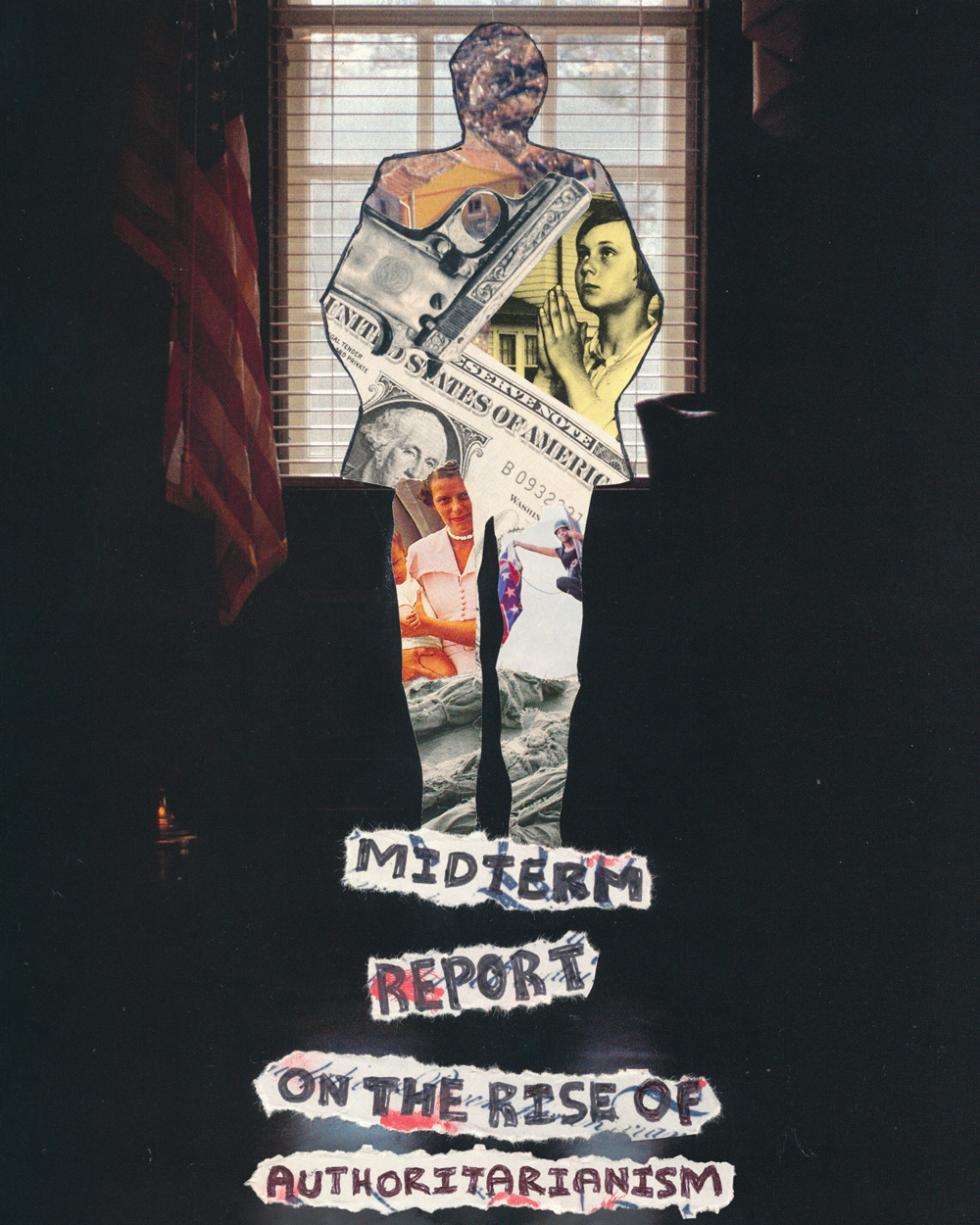
Midterm Report on the Rise of Authoritarianism
Kolaj LIVE Online:
Monday, 26 October 2026, 7PM EDT (2300 UTC)
LEARN MORE & GET TICKETS
Collage as a political art form has a particular relevance to today as well as a strong historical context. From its roots in the European anti-fascist and Russian revolutionary movements in the early 20th century to its expressions during the U.S. Civil Rights era to its current manifestations in the fight for social justice in South America, collage is used by artists around the world as an impetus for social and political change. Kolaj Magazine has reported on how collage was used to visualize the 2019-2021 Estallido Social in Chile which incidentally birthed a new collage community. In Fall 2021, Kolaj Institute organized a series of residencies in which artists explored the intersection of politics and collage. Led by G.E. Vogt, the residencies produced a collection of artworks that debuted at Kolaj Fest New Orleans in 2022 as an exhibition at The Domino. In July 2022, Kolaj Institute released Politics in Collage, a book of artwork, and an Online Exhibition. In November 2022, a third residency took place which resulted in a second book, Collage Saves the World. In April 2024, the artist residency and exhibition “Collage the Planet: Environmentalism in Art” took place at Kolaj Institute Gallery in New Orleans. A fifth artist residency in October 2025, Collage the Planet: Trash as Material, resulted in the exhibition, “Trash as Material”, at Kolaj Institute Gallery.
In January 2025, Kolaj Institute organized the residency, Politics in Collage 2025: Authoritarian Regime Survival Guide, that brought together collage artists to make artwork that responds to a global rise in authoritarianism. Artists in the residency worked together to illustrate and elucidate The Authoritarian Regime Survival Guide, a text written by Martin Mycielski, the Vice-President and Executive Director of the Brussels-based Open Dialogue Foundation. The folio of prints serves as a traveling exhibition. We began the residency on Inauguration Day. By the time we published the book–two hundred days into the administration–we were able to check off each of the items on Mycielski’s Authoritarian Checklist (see inside back cover of the zine). With the coming Midterm Elections, we thought it timely to again bring together a group of artists to make artwork about rising authoritarianism.
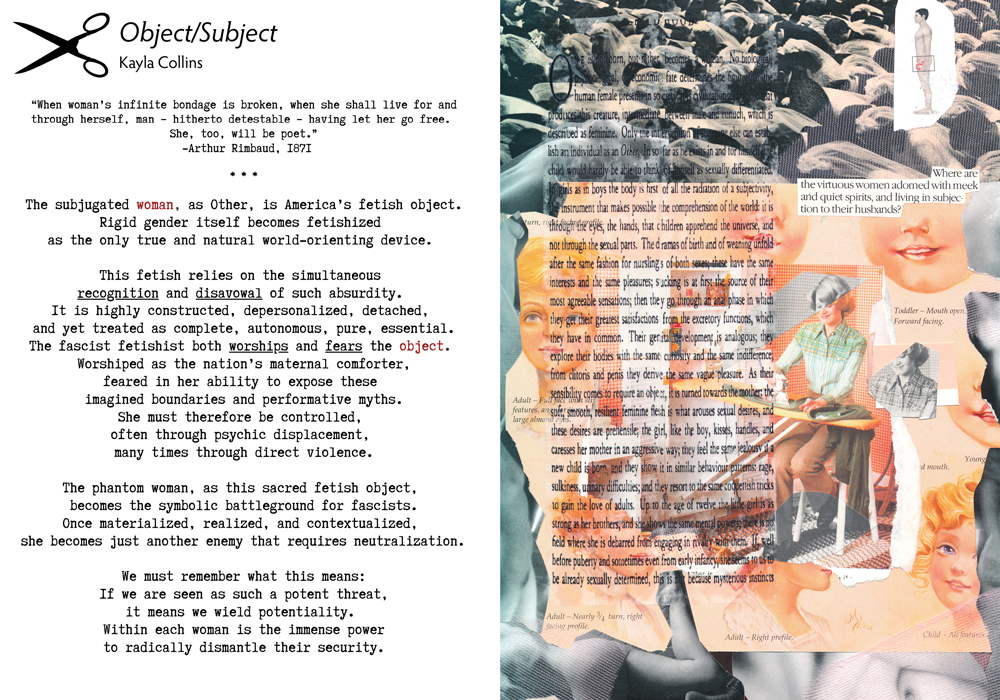
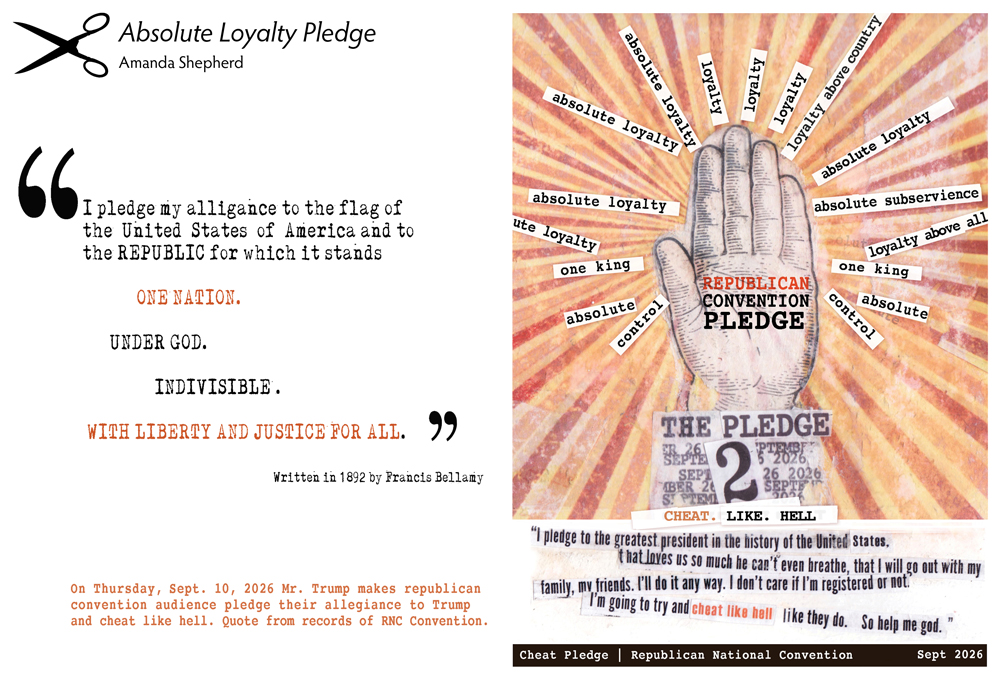
The residency was once again led by G.E. Vogt who, since 2021, has led a series of residencies in which artists explored the intersection of politics and collage. Vogt’s artwork consistently explores the crippling socioeconomic gap, the various forms of inequality prevalent in the U.S, and the toxicity of our political climate. The residency asked, How do we visualize the contemporary political moment? The five contemporary collage artists in the residency–G.E. Vogt, SDS, Andrea Lee, Kayla Collins, and Amanda Shepherd–set about to make artwork for the zine, Midterm Report on the Rise of Authoritarianism. The artwork speaks to a range of topics from economics, the environment, and militarization to religion, gender, and international relations and is contextualized with quotes, news reports, artist statements, and reading suggestions. We hope the zine will inspire others to draw upon their strength to use their voice and their creative skills to resist authoritarianism.
In the run-up to the residency, Vogt and Kolaj Institute Director Ric Kasini Kadour began to think about other ways to diffuse the project’s artwork. In previous eras of Kolaj Institute’s Politics and Collage project, we focused on the making of political collage, how art can impact political discourse; the difference between a poster, a meme, and an artwork; and specific issues and how to approach them. With this project, we wanted to think about how political artwork could be diffused into the public sphere and how that might inform how the artwork operates in the world.
German artist John Heartfield’s collages appeared on book jackets and magazine covers, as well as stage sets. He proved to be such a powerful critical voice against the Nazi Party that he rose to number five on the Gestapo’s most-wanted list. When German Jewish artist and writer Curt Bloch went into hiding in August 1943 he created the small magazine, Het Onderwater-Cabaret. “Until Curt Bloch’s liberation in 1945, he created 96 issues with a total of 492 poems on over 1,700 pages. The magazines were read by other people in hiding and their helpers,” reported a website created by Bloch family to keep his legacy alive.1
Today, one can see American artist Martha Rosler’s series, “House Beautiful: Bringing the War Home” (1967–1972), at the Museum of Modern Art in New York, but they weren’t made to hang in an art gallery. Rosler wrote in 1994, “At the time, in the 1960s, it seemed imperative not to show these works…in an art context. To show anti-war agitation in such a setting verged on obscene, for the site seemed properly the ‘street’ or the underground press, where such material could help marshal the troops, and that is where they appeared.”2 Rosler photocopied the collages and handed them out at anti–Vietnam War demonstrations.
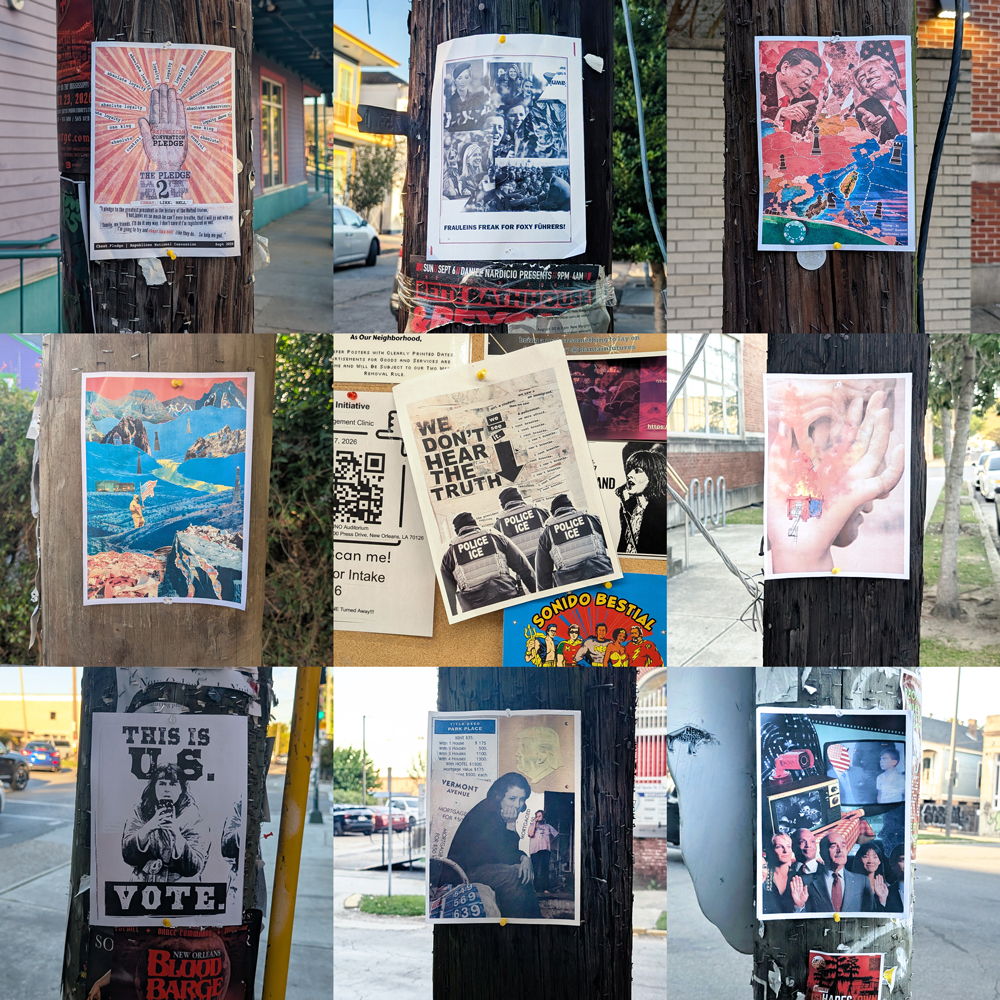
We would like to propose a similar diffusion strategy for the artworks in Midterm Report on the Rise of Authoritarianism as to that end we are publishing the artworks in four different ways. A professionally printed zine is available for purchase. A folio of prints is available for private and institutional collectors and as a traveling exhibition. We are also releasing the zine as a printable PDF (in color and black-and-white) that one can print double-sided, saddle stitch, fold, and trim. We are also releasing a printable PDF of letter-sized posters that we hope you will print and post as street art in your community. If you do, we invite you to send us a picture of the artwork in-situ.
In publication or exhibition or as street art, we want to demonstrate strategies for putting political art into the community. We also invite you to make your own collage that speaks to the politics of the moment and to put that collage out in your community be it on a telephone pole, the wall of a gallery, or in your own zine. If you do, we want to hear about it.
“I’m often asked the importance of political art; in the immense scale of everything that is happening in the world, what can political art really do?,” wrote Vogt. “This residency, the artwork that was created, the passionate conversations about how to be effective, the exploration of art in non-art spaces, is an answer to that question. It is not an attempt to end all wars so to speak, but it is a way to inspire hope and change in our communities, whether it is through greater community action, through affirming that an individual is not alone, or through opening a question in one person’s mind. We can’t know the direct impact of the art we put into the world, but through this residency and the art we create in this time of volatility, we choose action over apathy.”
Vogt continued, “We are in a time where it is easy to feel overwhelmed and helpless in the face of the volatility that is engulfing our communities; however, this is precisely the time that artists are called to action, to inspire hope and change in our communities through our art and our voices.”
1 Het Onderwater-Cabaret (n.d.). curt-bloch.com/en/history/het-onderwater-cabaret/
2 Rosler, Martha. (1994). Krieg in meiner Arbeit. Camera Austria, 47/48, pp. 69-78.
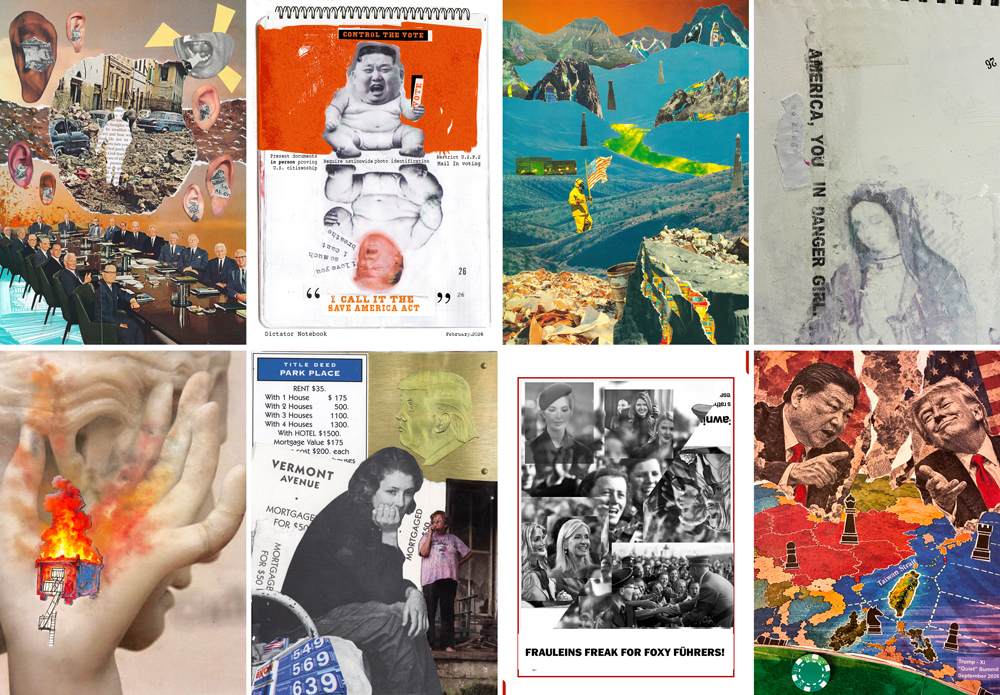
Folio: Midterm Report on the Rise of Authoritarianism
The folio “Midterm Report on the Rise of Authoritarianism” consists of seventeen, 15”x11”, collage prints on 100lb Strathmore Bristol Vellum paper in an edition of 5, plus one A/P. The folio is presented in an archival box with a label, a guide and a numbered title page signed by the curator.
One set of folios is included in Kolaj Institute’s archive. The remaining folios are available for sale with the proceeds going to support the mission of Kolaj Institute. The folio is also available as a traveling exhibition. Please send an email to inquire about exhibiting or purchasing folio.
Curated by Ric Kasini Kadour
CONTRIBUTING ARTISTS
Andrea Lee (Toronto, Ontario, Canada) is a Taiwanese-Canadian interdisciplinary artist, speechwriter, book editor and communication coach. She holds an MA in Interdisciplinary Studies with a concentration in communication and social change. She studied woodblock printing at the Karuizawa Mokuhanga School in Nagano, Japan and is a graduate of the Fibre Arts Program at the Haliburton School of Art and Design. She has shown her work in group shows in Ontario, at the Rochester Art Center in Minnesota, and at Kolaj Fest New Orleans 2025. Her work was featured in the book and folio, The Authoritarian Regime Survival Guide, published by Kolaj Institute in 2025. Her work is held in private collections in Canada, France, Japan, Taiwan, and the United States. www.andreajlee.com/art
SDS (Belmont, Massachusetts, USA) is a writer and visual artist. He is the author of five books, including Meet the Beatles (HarperCollins) and was a longtime commentator for the BBC, NPR, and CNN and a political columnist for the Boston Globe and Boston Phoenix. His art has been displayed across three continents and his poetry, visual poetry, and short stories have appeared in over 30 literary journals and magazines including The Guardian, The Atlantic, and The New York Times. His work has also been informed by his work as a legal consultant with several war crime tribunals in the Hague.
Kayla Collins (Northville, Michigan, USA) is an analog collage artist. Drawing from her background in sociology, psychology, and theopoetics, she approaches collage as an open-ended experiment that informs her uniquely synthesized style. Working solely with found, physical materials, her work incorporates a political “DIY” philosophy of the medium. Instagram @kalecollage.
Amanda Shepherd (Phoenix, Arizona, USA) is a multi-disciplinary artist whose practice of ceramics and painting blends word collage and transfer. The artist has shown her illustration work at Kerlan Museum at the University of Minnesota, Findley Museum of Findley, Ohio and has two public works currently on display in the Corpus Christi, Texas area. Instagram @mosheppo.
G. E. Vogt (San Diego, California, USA) led the virtual Residency, Politics in Collage: Midterm Report on the Rise of Authoritarianism. Since 2019, Vogt has become increasingly committed to working with and building a community of other socio-political collage artists. She participated in Kolaj Institute’s virtual Money Money Collage Residency, illustrating Eleanor Porter’s 1918 social commentary on capitalism and wealth, Oh, Money! Money!, with eleven other collage artists; and coordinated and directed two of Kolaj Institute’s “Politics in Collage” virtual residencies to further advance the field of socio-political collage, and help artists grow their work in this field. These residencies resulted in the books Politics in Collage and Collage Saves the World. Vogt was the artist-in-residence with Ideas Block LT in Vilnius, Lithuania in 2023. Currently, she is the curator of @art_of_resistance, dedicated to showcasing artists creating political work about contemporary issues, and the founder of “Project Postcards,” a guerrilla art campaign using postcards to raise awareness to the danger of Project 2025. Instagram @gevogtart.