
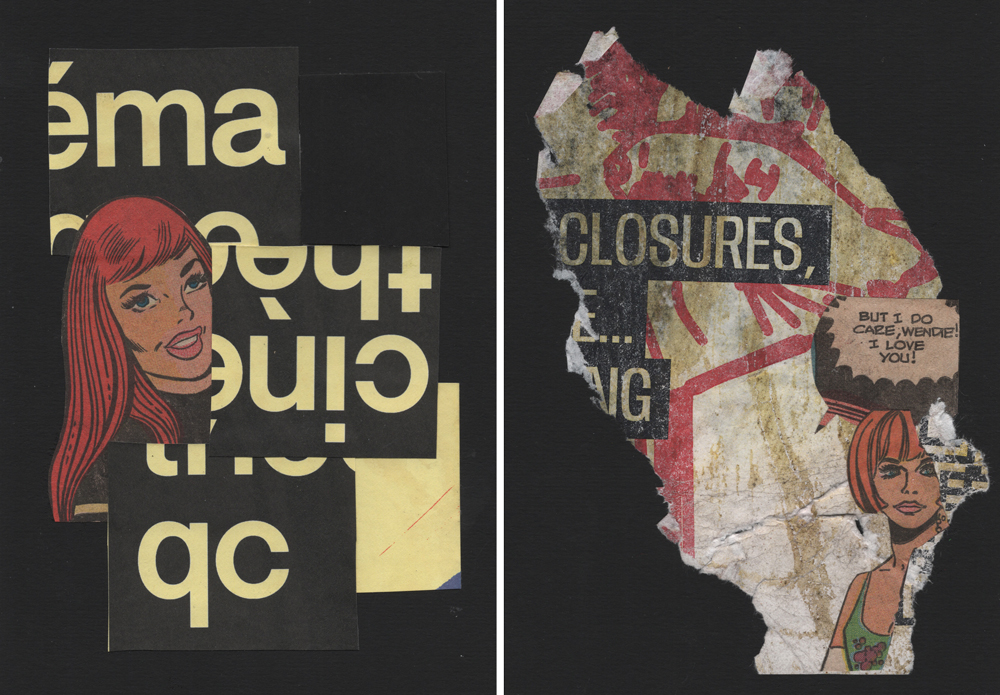
each image: 7″x5″; comic book, street poster; 2026. Courtesy of the artist
COLLAGE ON VIEW
Place as Archive
at Kolaj Institute Gallery in New Orleans, Louisiana, USA
1 October-14 November 2026
Kolaj Institute’s Place as Archive Project investigates how artists incorporate a sense of place into their collage art as a way of drawing out deeper, more complex stories. The project takes as its premise that the landscape can be viewed as a sort of archive from which artists can draw, not unlike a material archive maintained in an institutional collection. When artists approach a place as an archive, they draw out a deeper, more complex understanding of that place that enriches our understanding of our communities, helps us be better citizens, and empowers us to take better care of our neighbors.
The exhibition, “Place as Archive”, at Kolaj Institute Gallery from 1 October to 14 November 2026 is a commentary on how artists investigate and think about Place; specifically New Orleans, Montreal, and Scotland.
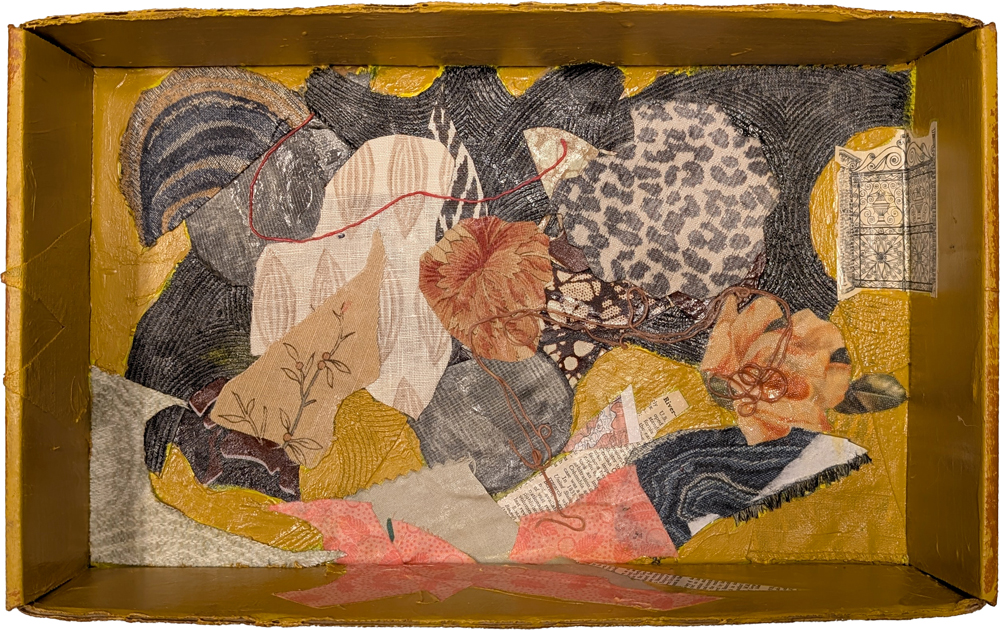
10″x16″x3″; fabric, thread, paper, found materials, acrylic; 2026. Courtesy of the artist.
Artists used illustration, photography, artist altar making, fabric arts, street rubbings, sound recordings, LiDAR and microscopic imaging to speak about the Mississippi River in New Orleans as a force of culture. A collaged circus strongman by New Orleans artist and Kolaj Institute volunteer Carol M Lynch holds up a dumbbell made of two baskets holding some of the great and not so great things one can find along the river or moving up and down it. Much of the artwork on view was made during Kolaj Institute’s The River Bends and So Must We Collage Artist Lab. Montreal, Quebec, Canada artist Andi Vicente built an artist altar that “speaks about endings, beginnings and the ongoing work of making worlds from what remains.” Based in Harlem, New York and North Carolina, USA, artist and writer Gia Anansi-Shakur drew on her New Orleans lineage to construct a river-based mythology of women. A collection of artwork by New Orleans, Louisiana, USA artist-scholar Mirzam Pérez speaks to how “the history of the United Fruit Company has opened another way of thinking about the river as a carrier—not only of water, memory, and life, but of commodities, labor, capital, and power. The manhole covers found on the streets in New Orleans spurred Great Barrington, Massachusetts, USA artist Johanna Merfeld to think about how the city drains itself into the River. After creating a series of charcoal rubbings she recreated the rubbings using oil pastel and collage. The sound collage, It Happened Before by Nashville, Tennessee, USA artist Patrick Irwin, uses historical data from the Carrollton gauge taken during the Great Flood of 1927 as a compositional device for a sound collage of contemporary field recordings of the Mississippi River. New Orleans, Louisiana, USA artist and designer Maya Sosland used LiDAR and microscopic images of the river (aerial and sediment) printed on clear film attached to fabric with magazine cutout underlays of living organisms that inhabit the river to reflect different methods and motivations for capturing the river–for scientific inquiry, for engineering planning, for pleasure, and for intrigue. Collage by Brooklyn, New York, USA artist Jennella Young took inspiration from Toni Morrison, Nina Simone, and “the things the river has witnessed, and the people and lives that have witnessed the river at different times, through different versions of its meander.”
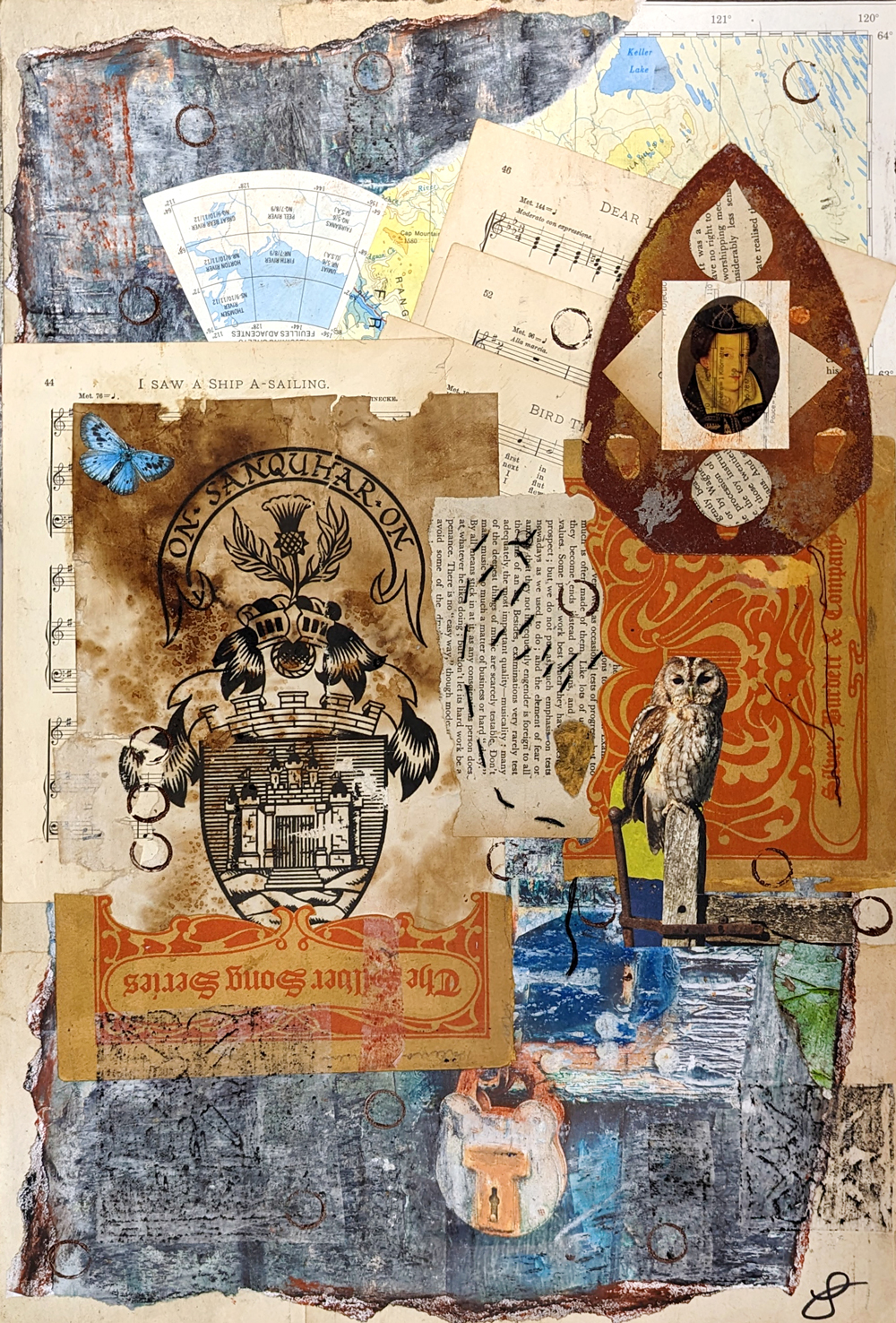
18.25×12″; sandpaper, printed and found historic material, maps, songbook, artist photographs, street debris, rubbings from the kirkyard, thread with acrylic on cardboard sealed in a gloss medium; 2023. B208AS23ART
During Kolaj Institute’s Passing Place: Collage Artist Residency in Sanquhar, Scotland, artists used the visual language of marketing, the layering of symbols and imagery, the folklore of the region, materials found while exploring the place, and historical research. Selling Sanquhar by Knoxville, Tennessee, USA-based artist Kira Evans uses the visual language of marketing to express ideas about place. Somewhere between vanitas and postcard, the collage, Ghost Bound by Boulder, Colorado, USA collagist Anita Nagpal Schwartz, meditates on urban migration and the choices someone living in Sanquhar might make about staying or leaving the community by layering symbols, some of which are unseen and buried in the collage as points of reflection. Tucson, Arizona, USA environmental educator and artist Carmen Bubar was drawn to the folklore of the region and the stories of witches in particular as a metaphor for belonging and acceptance. Saddleworth, Oldham, England collagist Diana Terry makes art “about how a place gets under your skin and how through the rhythms of making we can achieve a greater understanding of who we are.” Valencia, California, USA collage artist Paige Bridges became fascinated with a rookery behind the Blackaddie House Hotel and built a nest of found materials which she situated in an artist photograph. The ancestral family of Portland, Oregon, USA collage artist Justin Tuttle settled in West Virginia and this history led him to consider Sanquhar, Scotland’s coal industry. His collage “investigates the physical terraforming of the landscape, the bodies that did this Mining, and the deeply brooded political and environmental conversation that still maintains today.” White River Junction, Vermont, USA collagist Hettie Stearns carried her practice of only using found materials into the Artist Residency where she was drawn to the Sanquhar Brickyard, the remnants of a 19th century clay pit and kiln where sheep roam a field laden with pieces of broken terra cotta. Her collage speaks to the resiliency of the community. To make Wee Landscapes (Land Survey 1) Queens, New York, USA artist Stacey Burgay started by “building up layers of paper made of a mix of my photography and brochures from Scotland.” As she peeled back the paper until “the details gradually dissolve, echoing the transitory nature of memory itself.”
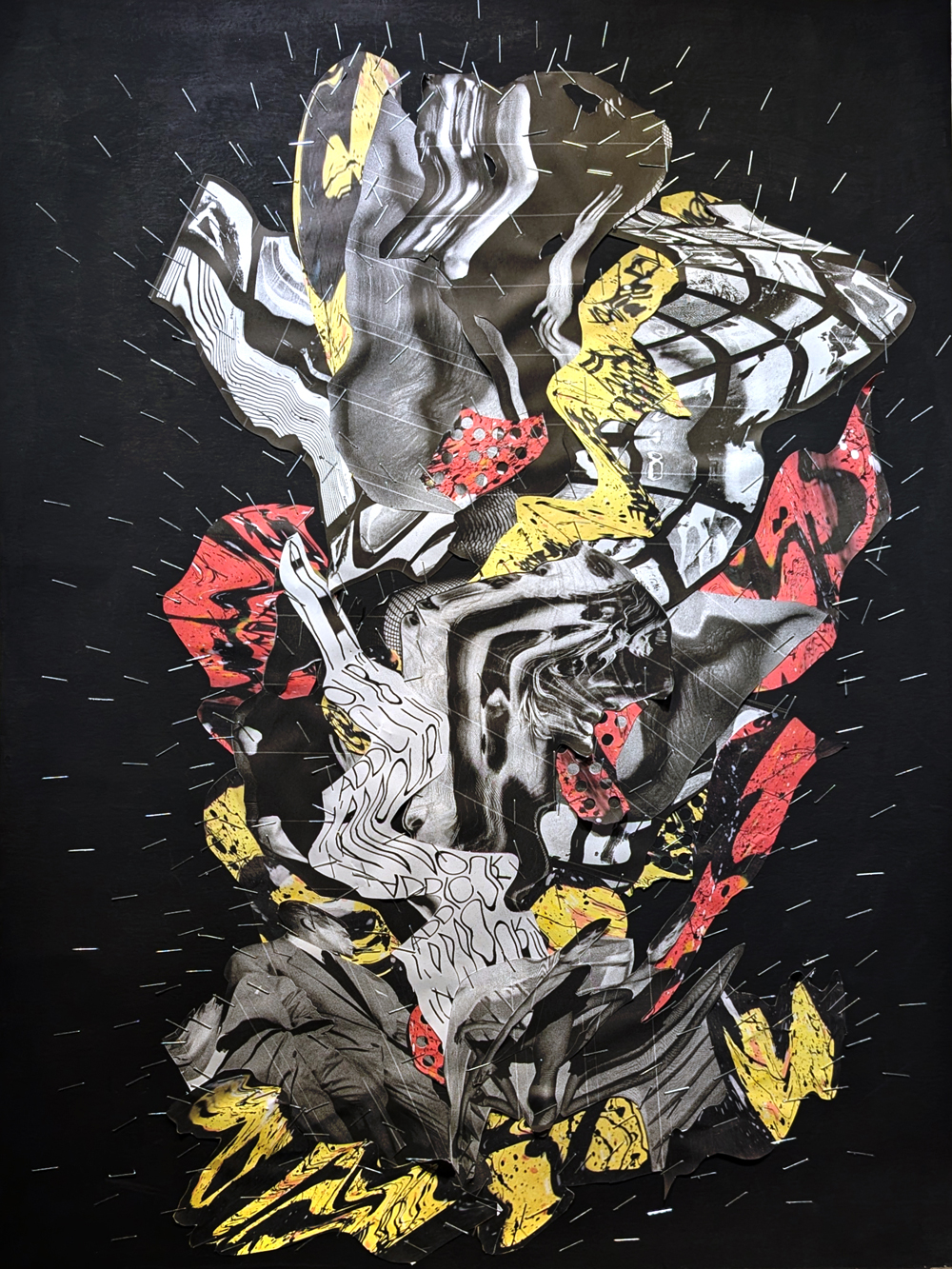
24″x18″; text from ELLE Québec, images from Paris Match: 60 ans, 60 photographes, lips from an unidentified magazine, artist photograph of Montreal graffiti, artist’s handmade graffiti, distorted version of Textures of Montreal, staples; 2026. Courtesy of the artist.
During Montreal: City As Archive Collage Artist Lab in Quebec, Canada, artists ripped old posters from alleyways, researched the geological formation of the land, considered the city’s nightlife, dressed the wounds of the city, made stories of those left out of official archives; brought uncomfortable histories into focus; and created visual diaries. Valatie, New York, USA artist Laura Cannamela used archival maps, handmade papers, and contemporary print ephemera to present a view of Montreal that puts human civilization in conversation with its geological history. Starting with an old event poster, the collages of London, Ontario, Canada artist Sarah Cowling hold the material resonance of the city while offering us a picture of its sense of place. Edmonton, Alberta, Canada artist Robin Duncan was informed by “graffiti, textures, paper pasted onto walls and poles, marks left on surfaces, architecture, and other traces of the people who had been there before me.” Naugatuck, Connecticut, USA artist Ernest Lopez explored Montreal’s Village, specifically Sainte Catherine, Ontario, and Atateken Streets “looking for those places where I think I see damage, stress or trauma that are revealed in cracks, crevices or missing portions of these various sites or places.” Auburn, California, USA artist Bar Davi explored the city’s garment district and the largely invisible immigrant workers whose labor helped shape Montreal’s history to excavate stories that remain largely absent from official narratives. Minneapolis, Minnesota, USA Denise Clemen was interested in the stories held by the Hôpital de la Miséricorde (Mercy Hospital), a facility that for 173 years starting in 1853 served orphans and single mothers and the history of the “Baby Scoop Era” when millions of young, unmarried women were compelled to give up their children. “The exuberance of youth, bodies on the street, garbage on the street, art on the street, so much happening on the street” caught the attention of Vancouver, British Columbia, Canada artist Dominique Norville who made a visual diary of her experience of the City.
Michael Sheringham wrote about learning to see places as living archives: “Many archives combine all sorts of matter; some of it vitally important and a lot of it just stuff, dross, repetitious bumph. But the other crucial ingredient is the idea of the archive as a process, something that takes place by virtue of the activities of compilation, preservation, juxtaposition, accumulation and so forth, that actually make archival space—at least potentially—active and dynamic. It’s the archive as a dynamic process that combines heterogeneous timescales, scrambles origins and mashes up elements from different horizons. That is what is exciting to us today…So, to think of a city as an archive is to think in terms of dynamic process, restless motion, multiple chronologies and levels of meaning.” That process is almost identical to collage.
“Art about Place offers a story that focuses our attention, inspires our curiosity, and shapes how we see things,” said exhibition curator Ric Kasini Kadour. “I believe, if we can see the world around us in a deeper, more meaningful manner, we will care about our place, our communities, and the people in those communities in deeper and more meaningful ways.”
ABOUT KOLAJ INSTITUTE
The mission of Kolaj Institute is to support artists, curators, and writers who seek to study, document, and disseminate ideas that deepen our understanding of collage as a medium, a genre, a community, and a 21st century movement. We operate a number of initiatives meant to bring together community, investigate critical issues, and raise collage’s standing in the art world.
ABOUT KOLAJ INSTITUTE GALLERY IN NEW ORLEANS
Kolaj Institute’s Gallery in New Orleans presents exhibitions and connects Kolaj Institute and the artists we work with to the vibrant St. Claude Arts District. We produce 8-10 exhibitions a year and participate in Second Saturday, the neighborhood’s monthly art walk, putting the collage art, books and exhibitions in front of New Orleanians and visitors. The Gallery is located at 2374 Saint Claude Avenue, Suite 230, at the corner with St. Roch Avenue on the 2nd floor. The marked door is on Saint Claude, look for the sandwich board sign when we are open. The Gallery is open Thursday-Saturday, Noon-6PM or by appointment.
INFORMATION
Kolaj Institute Gallery
Suite 230
2374 Saint Claude Avenue
New Orleans, Louisiana 70117 USA
Hours:
Thursday-Saturday, Noon-6PM
and by appointment