
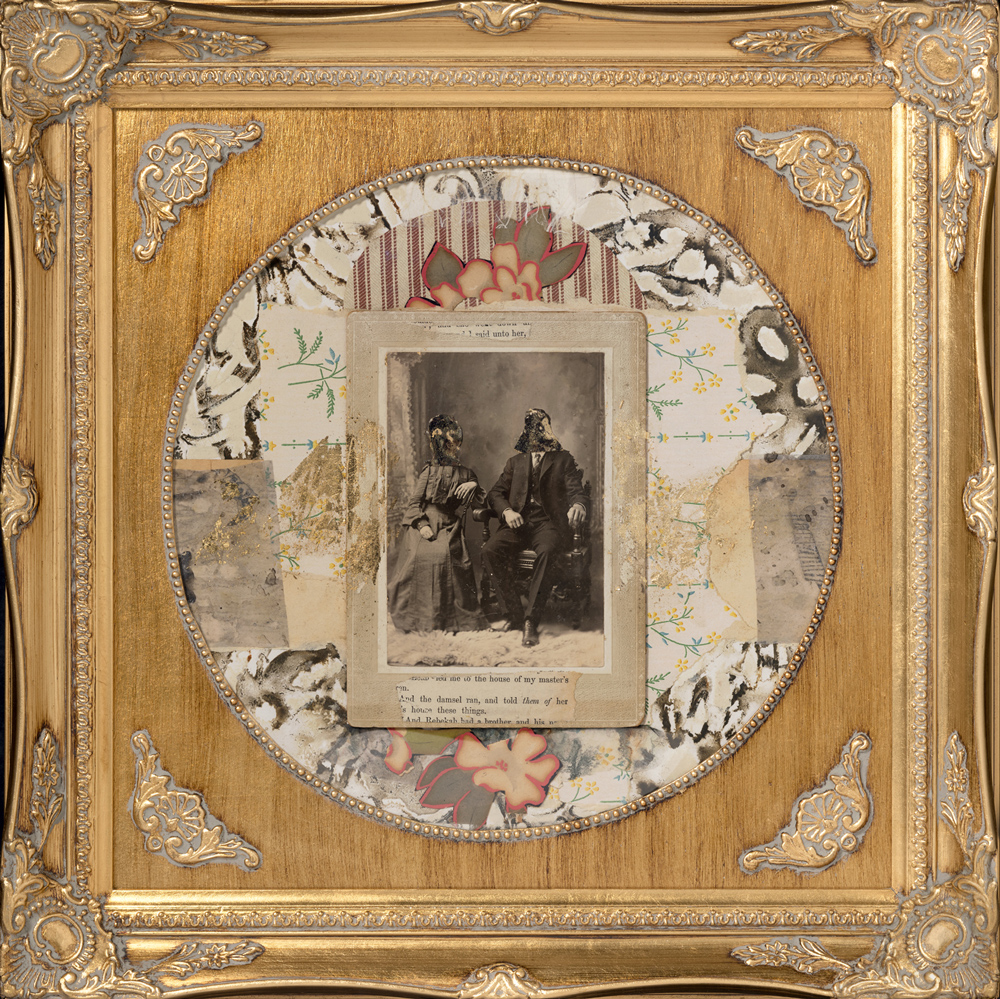
18″x18″x2″; deconstructed monoprint, found gold frame, vintage cabinet cards, gold leaf, dyed wax paper; 2024. Courtesy of the artists.
RESIDENCY UPDATE
Collage the Planet: Trash as Material Virtual Artist Residency
A four-week, virtual collage artist residency
Sessions: Four Tuesdays starting 25 November 2025, 6-8PM EST
In October 2025, Kolaj Institute opened an inquiry into Trash as Material. We brought together six artists in New Orleans to visit The Green Project and learn about how they process unwanted building materials and waste paint. They heard from New Orleans artist Jill Stoll about her “Lost Women” series and how she makes large woven artworks using post-consumer cardboard waste. The artists made artwork was part of the exhibition, “Trash as Material” at Kolaj Institute Gallery, 25 October to 29 November 2025.
“Once a thing becomes Trash, an entire new phase of the material object’s life begins, often one that demands the resources and labor of others,” wrote exhibition curator and Kolaj Institute Director Ric Kasini Kadour. “A small army of people, some paid, some not, collect litter from the streets. Entire industries exist to deal with trash objects. Most of those industries exist to move trash around: It gets collected and carted off to a landfill. Sometimes the Trash is sorted and re-commodified as a raw material. A few organizations are committed to redirecting materials back into communal use.”
In the post-use life of materials, what role do collage artists play? And what happens when collage artists use trash as material? Taking the premise that Trash is not simply a material, but an idea, artists will virtually assemble to explore art made with or about Trash. Themes that have already emerged through Kolaj Institute’s inquiry into this subject have included Trash as Archeology; the role of labor; litter and other street Trash; food waste; the history of sanitation; picking and hoarding; class, race, and questions of social justice; Trash and place; planned obsolescence; e-waste; and how to develop relationships with sources of particular Trash material and then physically process Trash into art materials. In this residency, artists will hear about these themes; about how artists made art about them; and identify new themes.
In collage, materials are never neutral. From how they are sourced to how they are used, the material a collage is made of shapes the story and experience of the artwork. The residency considered what making art with Trash means for an Artist’s Practice and what strategies an artist can use to move their work through the art ecosystem.
Artists heard from Seattle, Washington artist, curator and place maker Bill Gaylord, who, during his Solo Artist Residency in June 2025, explored New Orleans by becoming an urban scavenger. “A common medium in my work is using repurposed cultural detritus, plastic, paper and wood found objects reflective of a particular place and cultural identity,” wrote the artist. “I was taught from an early age to conserve resources, repurpose and recycle used materials concurrently with becoming a young artist creating collages. I was head of the recycling committee in High School where I started creating art with trash. Later in life as an architect and artist I educated myself in the epidemic of non-recyclable plastic trash and the gyres of garbage collecting in all of earth’s oceans. I made it a mission to create wearable art out of trash and educate the public as well as raise money for non-profit organizations through trash fashion as well as in my studio practice collage artwork. Found objects and trash, both two and three dimensional, I find to be inspiring materials to use in my art no matter what medium or scale.” Gaylord spoke about his artist practice and the role of Trash in his artmaking.
Ric Kasini Kadour presented an international, historic survey of artists that used trash in their work, from German Dadaist Kurt Schwitters to Brazilian artist Vik Muniz to Ghanaian artist Serge Attukwei Clottey, and speak about how materials are never neutral in collage. Kadour also presented an overview of Kolaj Institute’s Trash as Materials project and shared examples of how other artists have made work that spoke to the subject. As the project curator, Kadour guided artists through a process of building context for their artwork that supports its diffusion and ultimately its engagement with viewers.
Using Michael Thompson’s Rubbish Theory: The Creation and Destruction of Value (2017 edition) as a key point of reference, artists were invited to identify the type of Trash they wished to use as material and then work with the collective knowledge of the group to make a plan to source and process that material and ultimately turn it into an artwork or installation. Artists also developed a context for the artwork that included the source of the Trash and what stories or ideas informed the viewers’ experience of the artwork. Group discussions centered on how to develop a contemporary art project and how to bring that artwork to a community.
OUTCOME
The goal of this residency was to support collage artists as they adapted their artist practice to speak to the complexities of environmental issues and contribute to a broader dialogue on sustainability and ecological consciousness. During the residency, artists considered how elements of their practice (research & play, process, making, finishing, diffusion, and impact & engagement) can be adapted.
At the end of the residency, artists were invited to submit artwork to the exhibition that will take place at Kolaj Institute Gallery in New Orleans in late 2026 and to a book about Trash as Material that will be published in 2027. Other opportunities to diffuse the artwork include articles in Kolaj Magazine or participating in a Kolaj LIVE Online program, or being on panel at Kolaj Fest New Orleans, 10-14 June 2026.
PARTICIPATING ARTISTS
Nancy Kay Turner (image above) is a Los Angeles artist, art critic, and founder of the Hana Kark art collective. Her work is in private, public and corporate collections, including: The Hawai’i State Foundation for Culture and the Arts, Warner Brothers Studios, ABC Studio, Glendale College, Chiat/Day Advertising Agency. Turner’s essays have been published in the “Perceive Me” catalog and in the print issue of Riot Material. A transcription of her talk on the artist Roland Reiss’s work at The Oceanside Museum of Art, is archived at The Smithsonian. She has written art criticism regularly since 1984 for Artweek, Artscene, Coagula, Riot Material, ArtandcakeLA, and DiversionsLA. She taught at the Loyola College Preparatory of Los Angeles and was an Adjunct Assistant Professor at Glendale College. Turner was an AP studio Art reader for 11 years. Learn more at www.nancyturnerstudio.com.
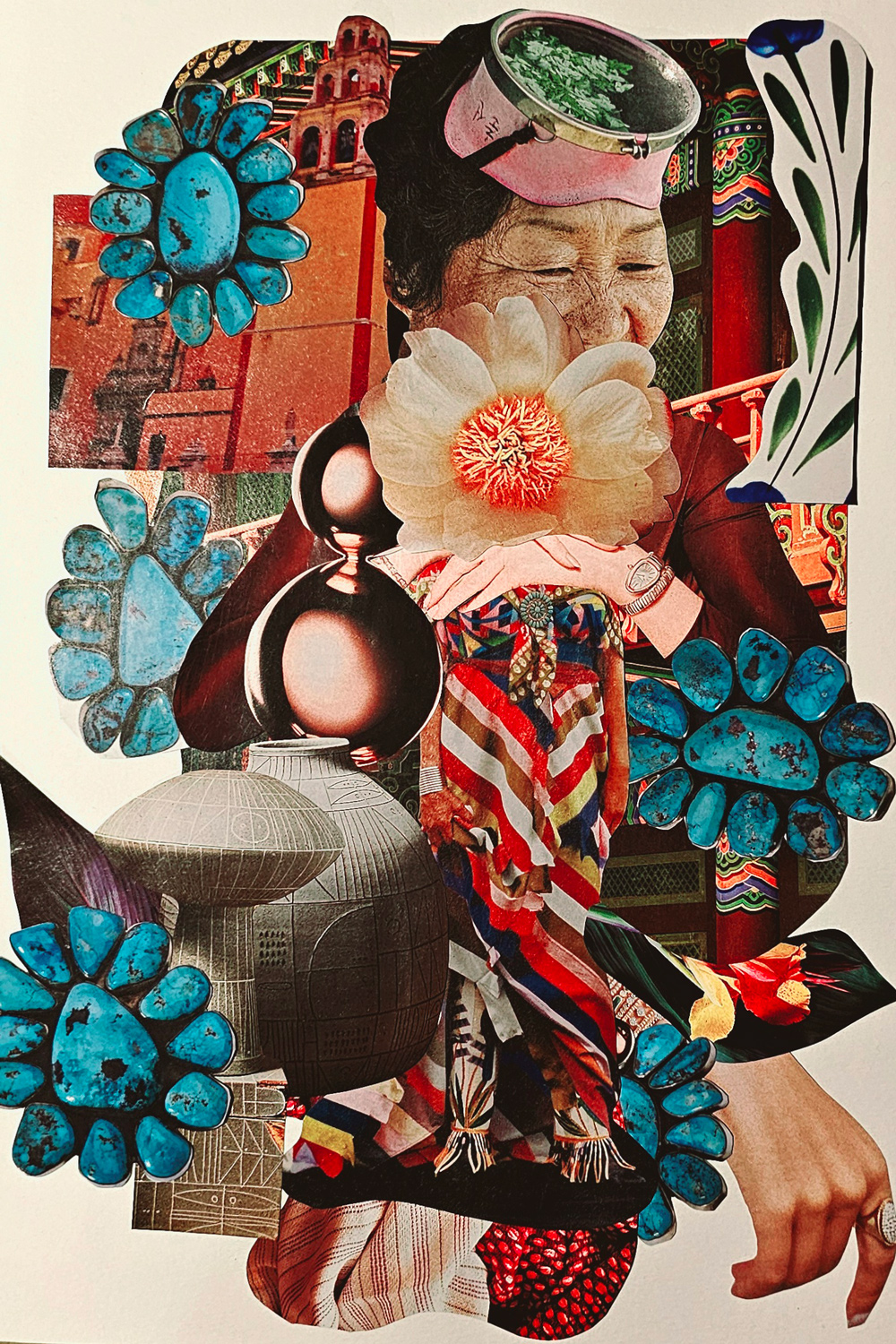
14″x11″; magazine cuttings, gel medium; 2024. Courtesy of the artist.
Ann-Denise Anderson, M.Ed., is a multidisciplinary collage artist and educator whose work fuses discarded materials, female gesture, memory, and urban landscape to explore transformation, reclamation, and visual storytelling. As a practicing artist, Anderson draws deeply from her work as a longtime Visual Arts educator and mentor in Fort Worth, Texas, where she has fostered thriving creative communities and supported emerging student artists through portfolio development, public exhibitions, and competitive programs such as VASE and AP Studio Art & Design. For over fifteen years, she has championed equitable arts access and collaborative arts culture. Her leadership has been recognized through district-wide teaching honors and numerous student achievement accolades. In addition to her studio practice, Anderson writes about visual arts, educational leadership, and creative practice, contributing articles and reflective pieces to arts and education publications. Learn more at anndenise.anderson.blogspot.com.
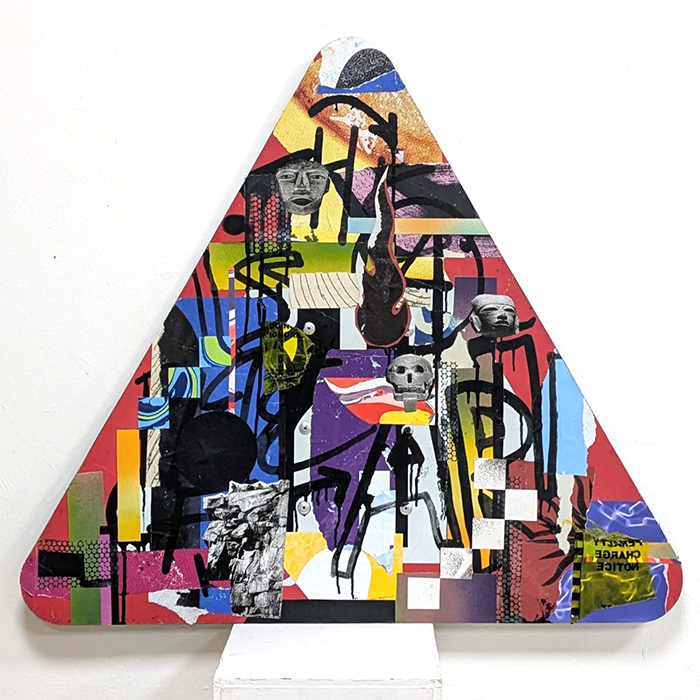
29.5″x29.5″x29.5″; road sign, found billboard paper, parking ticket, marbled paper, monoprints, magazine, spray paint, street dabber, acetate; 2025. Courtesy of the artist.
Becky McGillivray, based in Stockport, Cheshire, United Kingdom, is a multidisciplinary artist and muralist who began her career as an artist after studying illustration at university. She has painted vibrant, bold typographic murals in England for communities and clients alike for the past four years and is driven by a mission to make public art more accessible. She founded Overspray Collective in 2023, which aims to make public art accessible and safer for marginalised groups. As part of the collectives’ establishment, she took part in Union 2024: The Northern School of Art and Activism, where she became engrossed in how public art can be activism and has designed and installed over 30 public artworks in England during this time. Learn more at www.beckymcg.com.
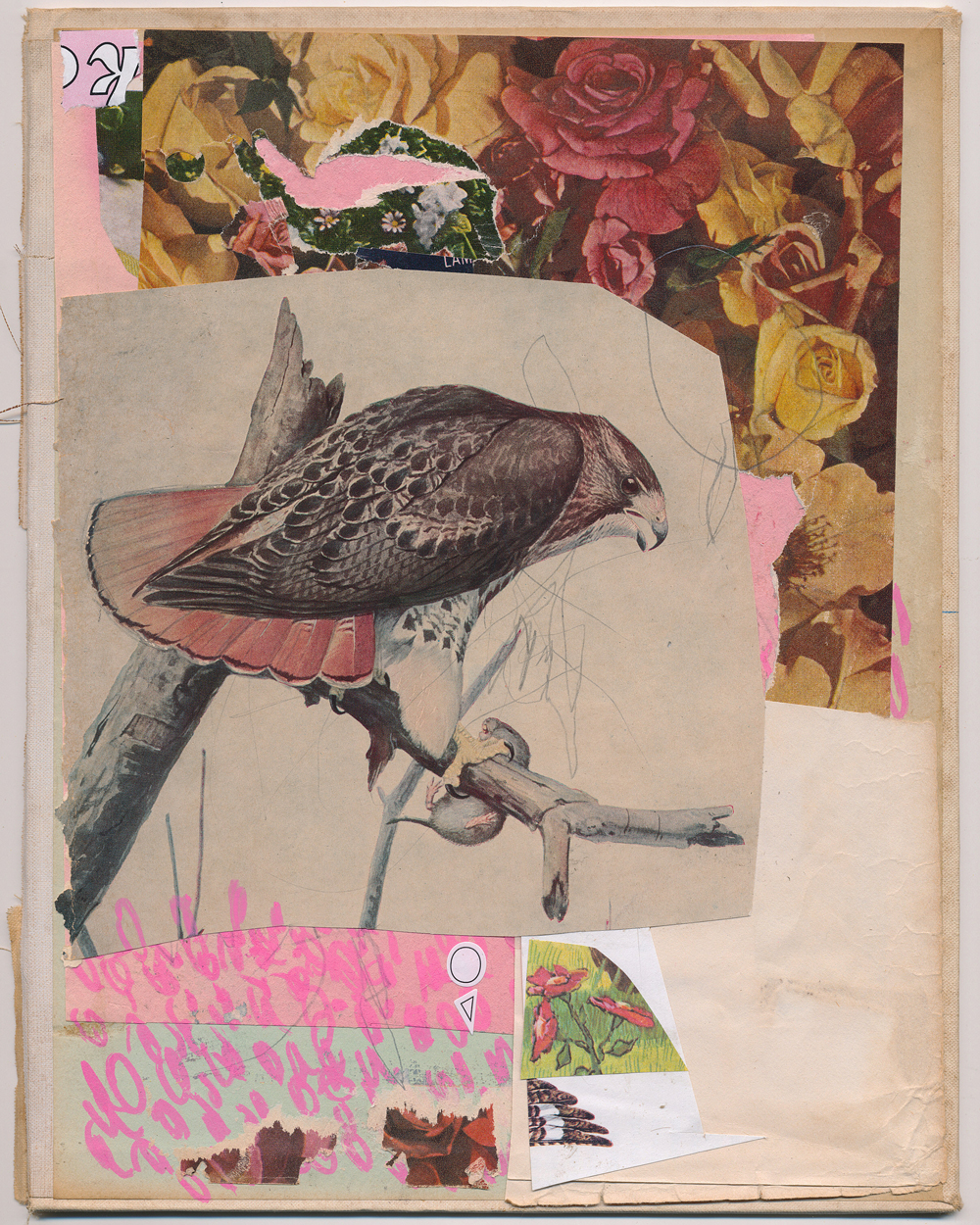
9.75″x7.75″; book cover, paper, UHU glue, posca pens, pencil; 2025. Courtesy of the artist.
Cait Elizabeth is a self-taught mixed media artist focusing on analog collage. She is originally from England, but currently lives in Texas. Her work has been exhibited locally at the Lewisville Grand Theater and The Eclectika. Her work has featured in Wilder Magazine, Cut Me Up Magazine and Women United Art Magazine. Learn more on Instagram @archtwice.
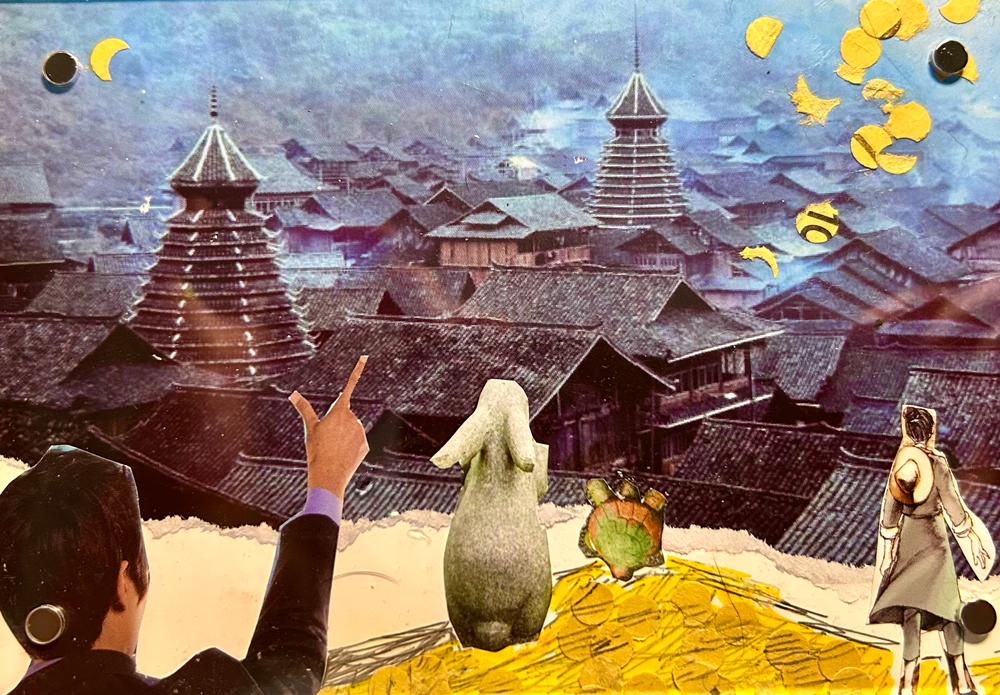
3″x5″; collage; 2024. Courtesy of the artist.
Denver, Colorado-based Jeannene Bragg is a mixed-media and performance artist. Part of Denver’s performance and art scene for more than 30 years, Braggs’s current and recent work includes: devising “Gin and Gothic” (a theatre piece) with Band of Toughs collaboratory, directing the Public Art program at Denver Arts and Venues, exhibiting collages in the Biennial of the Americas’ Double Vision show, creating justic performances using Theatre of the Oppressed methodolgy, and crafting an experimental performance that emanates from the discoveries of Marie Curie, featuring collaged projections and new music.
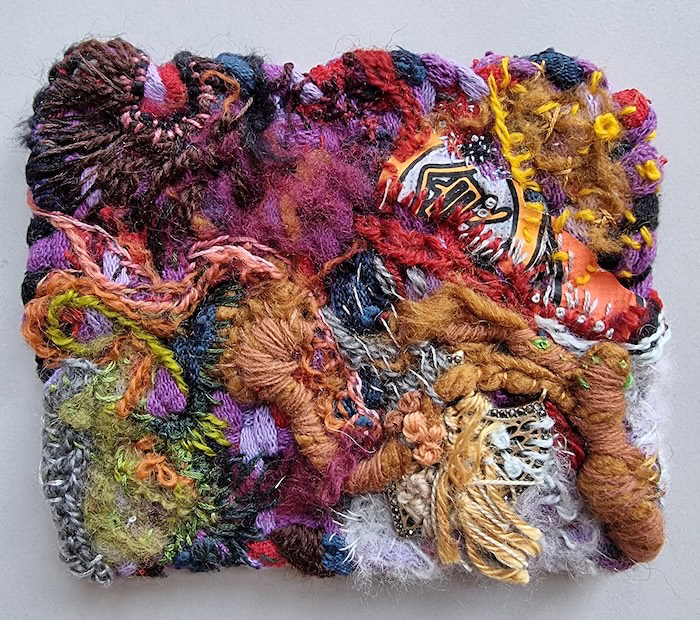
4″x5″; cotton loom loop, wool, cotton floss, metal scrap and food packaging; 2022. Courtesy of the artist.
Kathryn Lineberger is a writer, musician, painter, and textile artist originally from Ohio. She studied graphic design at Kent State University, millinery at Fashion Institute of Technology, and later earned a BA in psychology from John Jay College and an MA in communications from Baruch College. Now a longtime New Yorker, she has honed her multimedia practice in community arts workshops and exhibits her work on the Lower East Side of Manhattan. Learn more HERE.
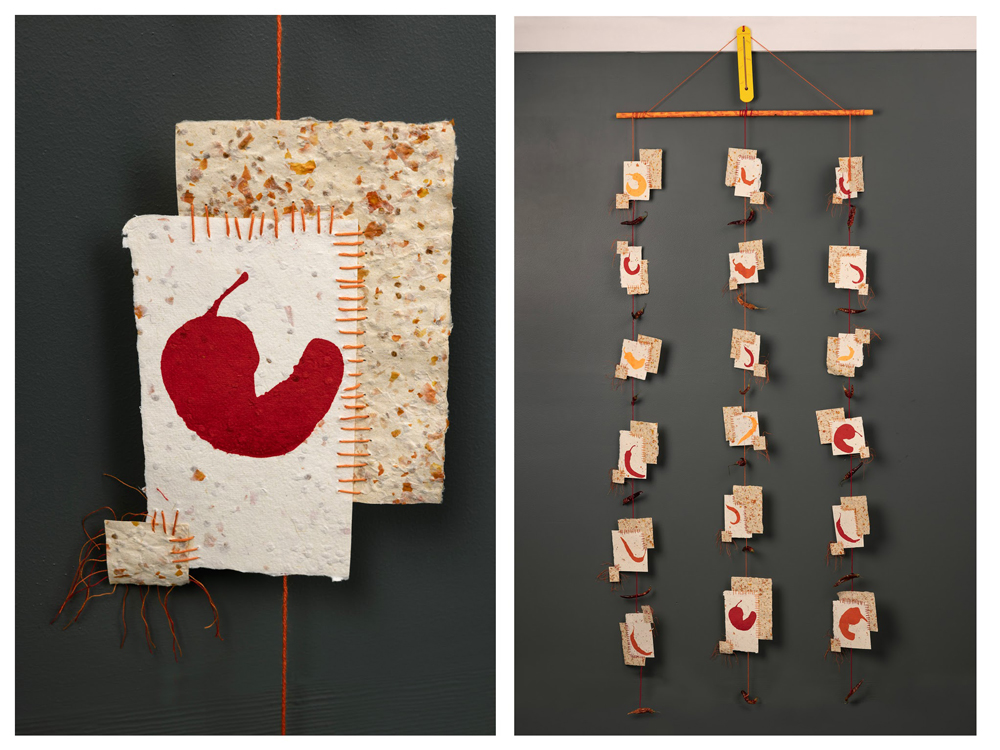
108″x36″x1″; handmade paper (peppers, cotton, and abaca), screen printing, thread, yard, wood, ink, and a thermometer; 2023. Courtesy of the artist.
Rose Menyon Heflin grew up running barefoot, wild, and free among rural, southern Kentucky’s fields and forests. Although her academic background is primarily in environmental studies and ecology, she is now a poet, writer, and visual artist. With over 250 poems published in outlets spanning five continents, her writing has won multiple state and national awards and been nominated for a Pushcart Prize. Besides poetry, she has also published memoir, essay, flash fiction, and journalistic pieces. Her visual art has been featured in numerous state- to international-level group shows, including the North American Hand Papermakers’ 2023 Juried Exhibition Triennial Sustainability in Chaos. Additionally, it appeared on a Times Square jumbotron twice and has exhibited locally around Madison, Wisconsin many times. She has had over a dozen art pieces published in everything from free collage making kits to international journals, was featured twice in a row in Access to Independence’s Artists Beyond Boundaries Calendar, and won a 2025 Arts for All Wisconsin Creative Power Award. Learn more at www.artworking.org.
ABOUT THE FACULTY
Bill Gaylord is an artist, art curator and former architect living in Seattle, Washington, USA. He holds degrees in art and architecture from the Rhode Island School of Design. A lifelong artist, place maker and community arts activist, he was recognized and inducted as a Fellow of the American Institute of Architects in the category of “Service to Society” in 2012. After attending a School of Visual Arts Public Art program in New York City, he founded BONFIRE Art. Culture. Design. (2013-2023), an art curation business, community art gallery and a studio space for his art practice. The artist works out of Seattle’s Base Camp Studios. He has shown his collage work at CoCA in Seattle, the Woods Gerry Gallery at RISD, and at BONFIRE, among other venues. A passionate advocate for the Art as Medicine movement Gaylord serves on the Path with Art board in Seattle where he actively participates in arts engagement programs to restore individuals working through a broad spectrum of traumas. Learn more at www.thisisbonfire.com.
Ric Kasini Kadour, a 2021 Andy Warhol Foundation for the Visual Arts Curatorial Fellow, is a writer, artist, publisher, and cultural worker. Working with the Vermont Arts Council, Kadour curated four exhibits: “Connection: The Art of Coming Together” (2017) and Vermont Artists to Watch 2018, 2019 and 2020. In 2017, he curated “The Art of Winter” at S.P.A.C.E. Gallery in Burlington, Vermont. In 2018, Kadour curated “Revolutionary Paths: Critical Issues in Collage” at Antenna Gallery in New Orleans, which bought together collage artists whose work represents the potential for deeper inquiry and further curatorial exploration of the medium; followed in 2019 by “Cultural Deconstructions: Critical Issues in Collage” at LeMieux Galleries in New Orleans, which furthered the conversation; and “Amuse Bouche”, also at LeMieux Galleries in 2023. Since 2018, he has produced Kolaj Fest New Orleans, a multi-day festival & symposium about contemporary collage and its role in art, culture, and society. As Curator of Contemporary Art at Rokeby Museum in Ferrisburgh, Vermont in 2019 and 2020, he curated three exhibitions, “Rokeby Through the Lens” (May 19-June 16, 2019), “Structures” (August 24-October 27, 2019), and “Mending Fences: New Works by Carol MacDonald” (July 12-October 25, 2020). He also curated “Contemporary American Regionalism: Vermont Perspectives” (August 17-October 20, 2019); “Where the Sun Casts No Shadow: Postcards from the Creative Crossroads of Quito, Ecuador” (November 1-30, 2019); and “Many Americas” (August 20-November 27, 2022) in the Wilson Museum & Galleries at the Southern Vermont Arts Center. “The Money $how”, co-curated with Frank Juarez, was presented at the AIR Space Gallery at Saint Kate-The Arts Hotel in Milwaukee, Wisconsin (April 10-September 12, 2021). For Birr Vintage Week & Arts Festival in Birr, County Offaly, Ireland (August 13-20, 2021), he curated “Empty Columns Are a Place to Dream”, which traveled to the Knoxville Museum of Art in January-February 2022. At 516 ARTS in Albuquerque, New Mexico, Kadour co-curated with Alicia Inez Guzmàn two exhibitions: “Many Worlds Are Born” (February 19-May 14, 2022) and “Technologies of the Spirit” (June 11-September 3, 2022). In 2023 at the Knoxville Museum of Art, Kadour curated “Where the Sun Casts No Shadow: Postcards from the Creative Crossroads of Quito, Ecuador” (January 9-February 16, 2023) and “Mystical Landscape: Secrets of the Vale” (March 17-May 28, 2023). In September 2023, he curated “Word of Mouth: Folklore, Community and Collage” at A’ the Airts in Sanquhar, Scotland. At Kolaj Institute Gallery, he curated “Grand Opening Exhibition” (March 9-April 14, 2024), “Collage the Planet: Environmentalism in Art” (April 19-May 26, 2024), “Magic in the Modern World” (June 1-August 11, 2024), “Advanced Wound Healing Techniques: Collage by Robbie Morgan” (August 16-October 6, 2024), “Temporal Geolocation: How Place & History Inform Identity in Collage” (October 11-November 24, 2024), “Camera & Collage” (November 29, 2024- January 25, 2025), “Joy and Grief: An Exhibition of Collage” (April 12-May 31, 2025), “Collage As Art Movement” (June 14-August 31, 2025), “Big Orange Monster: An Emergency Collage Exhibition” (September 10-October 18, 2025), and “Trash as Material” (October 25-November 29, 2025).
His first short film, The Covenant of Schwitters’ Army, debuted at Collage on Screen during Kolaj Fest New Orleans 2023. His second, Joy Is Paper, debuted at Collage on Screen during Kolaj Fest New Orleans 2024. Kadour is the editor and publisher of Kolaj Magazine. He has written for a number of galleries and his writing has appeared in Hyperallergic, OEI, Vermont Magazine, Seven Days, Seattle Weekly, Art New England (where he was the former Vermont editor) and many others. Kadour maintains an active art practice and his photography, collage, and sculpture have been exhibited in and are part of private collections in Australia, Europe and North America. In January-February 2020, he was artist-in-residence at MERZ Gallery in Sanquhar, Scotland. He holds a BA in Comparative Religion from the University of Vermont. Kadour splits his time between Montreal and New Orleans. www.rickasinikadour.com