
KOLAJ LIVE ONLINE
Folklore on Parade
Thursday, 26 March 2026, 7PM EDT (2300 UTC) on Zoom
GET TICKETS
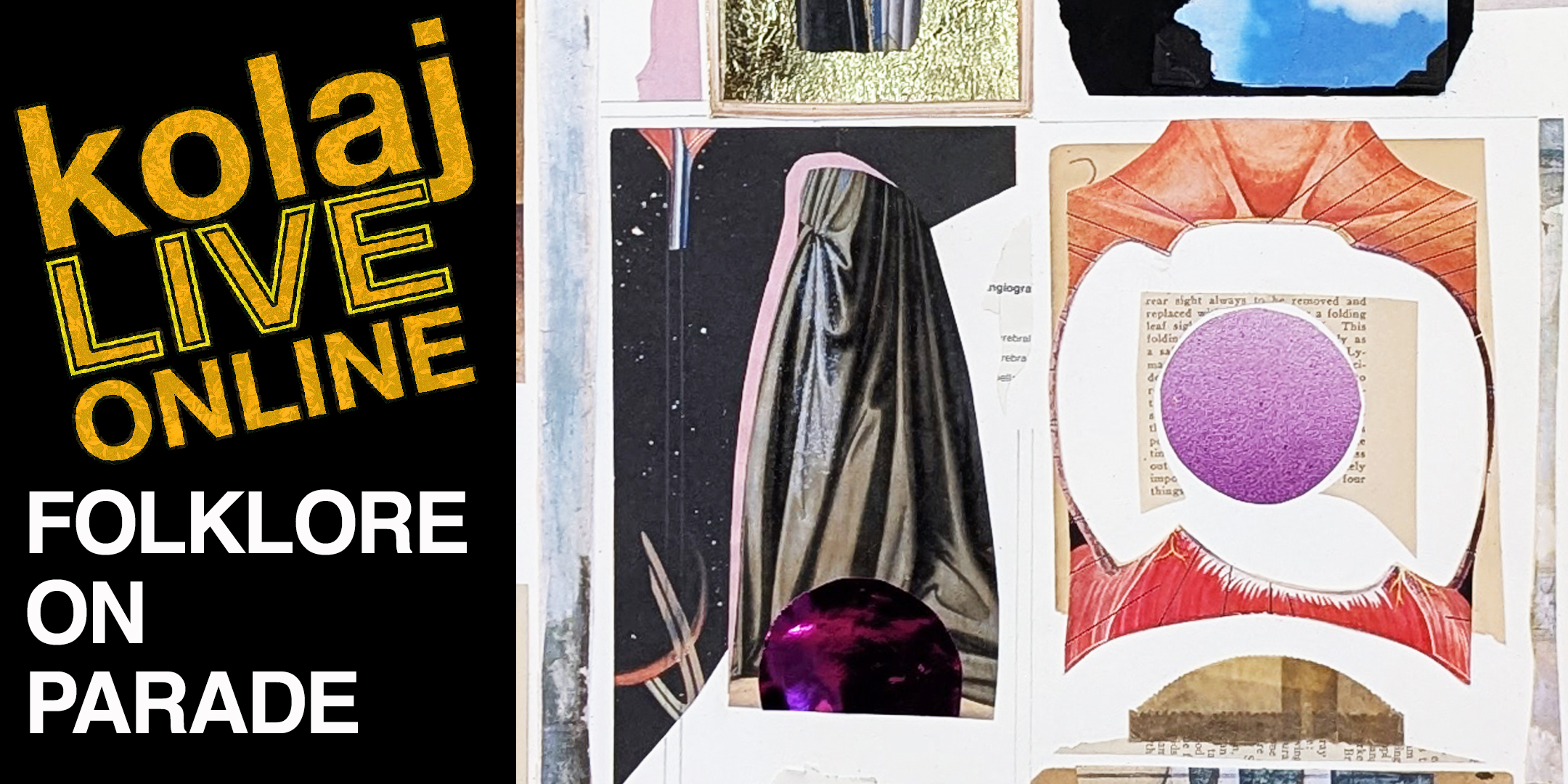
“Folklore on Parade,” the current exhibition at Kolaj Institute Gallery in New Orleans, brings together the work of sixteen artists, each of whom are speaking to ideas about carnival and folklore and its role in our communities. During this edition of Kolaj LIVE Online, curator Ric Kasini Kadour will present a virtual tour of the exhibition and we will hear from some of the artists whose work is on view.
“Carnival in New Orleans could be considered the largest, ongoing folklore festival in the world,” wrote curator Ric Kasini Kadour. We will hear from Jennifer Evans (Denver, Colorado, USA) whose collages juxtapose contemporary women of Carnival with their 19th century antecedents. Faith, Justice, Power by Charulata Prasada (Montreal, Quebec & Ottawa, Ontario, Canada) is based on the colors of Carnival and is part of a larger series that invites viewers to remember the economic, social, and political history from which Carnival arose.
Some of the artwork in the exhibition speaks to how the line between Folklore and History is often blurry. Tiffany Wilson (Reston, Virginia, USA) will speak about how her collage brings the story of Bluebeard into a 21st century context. While told as a folktale in France, some evidence suggests the stories are rooted in historical individuals in Brittany. Telling Tennessee Tales II by Atlanta, Georgia, USA artist CoCo Harris tells the story of Nathan “Nearest” Green (1820–1880), the invisible, historical protagonist at the center of American Whiskey lore and history.
Artists in the exhibition made artwork that speaks to the folklore surrounding death and change. Kayte Terry (Philadelphia, Pennsylvania, USA) spent two weeks in New Orleans as a participant in Carnival as Folklore Artist Residency and as a Solo Artist in Residence at Kolaj Institute and was inspired by a quote from Rebecca Solnit and Rebecca Snedeker’s 2013 book, Unfathomable City: A New Orleans Atlas, “In most parts of New Orleans, if you plant your arm into the ground to the depths of your elbow, your fingertips will touch water. Your fingertips might also touch other fingertips…” The Passing Hour by Tracy von Ahsen (New York, New York, USA) does not reflect a single piece of folklore, but rather her broad research into “how thresholds function as moments of risk, pause, and irreversible change.”
Trish Crapo (Leyden, Massachusetts, USA) contributes to the exhibition a collection of eight collages that explore what it means for an artist to seek magic outside of their community and tradition.
“Folklore on Parade” is a beginning. Kadour will speak about upcoming forums, articles, residencies, and exhibitions and how artists can become involved with Kolaj Institute’s Folklore Collage Society.
ABOUT FOLKLORE COLLAGE SOCIETY
Kolaj Institute’s Folklore Collage Society project considers the role artists play in activating, transmitting, and celebrating folklore in communities as a form of cultural expression and a strategy for community resilience. In addition to a periodic printed journal, Folklore Collage Society manifests as artist residencies; articles in Kolaj Magazine; programs at Kolaj Fest New Orleans and Kolaj LIVE Online; and exhibitions.