
Wim Botha
28 April-10 June 2017
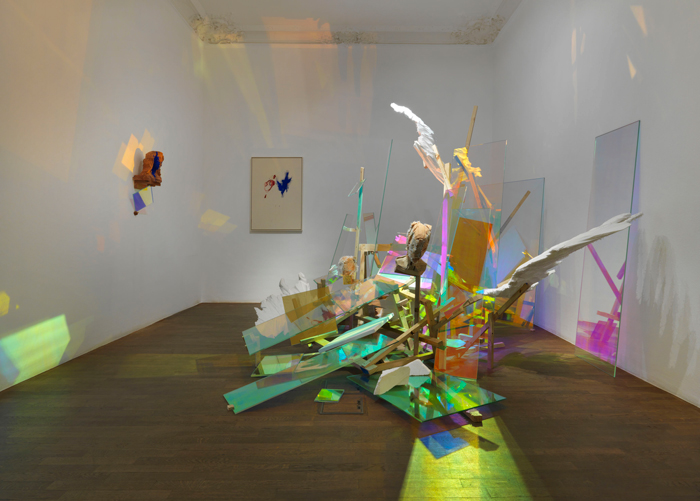
South African artist Wim Botha created an installation that makes use of Feldbusch Wieser Rudolph’s entire gallery space. It consists of overlapping glass plates that reflect one another and provide the artificial cosmos within which the artist situates his fascinating sculptures. His works include portrait busts, monumental heads of the Virgin Mary and wings that resemble prisms, but also non-representational paintings on canvas and paper.
In this multifaceted laboratory, Botha’s paper busts are especially striking. They are sculpted from books that are milled to reveal distinctive facial expressions. Botha became known to an international audience when he presented these busts at the Venice Biennale in 2013. They act as anchors in the loosely composed space, even though they themselves hover like theater props on simple slat constructions.
Noticeable in the exhibition is the way in which Botha mixes and matches the most diverse of materials, such as wood, marble, glass, and polystyrene, as well as, more recently, crystals grown from copper sulfates. Thus, a monumental head, sculpted from layers of reddish wood, lies on the floor, and with its sightless eye made of dazzling white Carrara marble, it withdraws from entering into direct dialogue with the viewer. By contrast, the two heads of the Virgin Mary, one is small and one is monumental, look relatively meditative; Yves Klein blue has been drizzled over their enraptured facial expressions, thereby positioning them in an intermediate world in which they oscillate between blue screens that resemble media monitors and Christian-iconographic historical contexts. The processual nature of Wim Botha’s installation seems to visualize the uncertainty of the future while, simultaneously, the past is absent.
In the exhibition’s second room, Botha captures the viewer’s attention with an installation that makes use of the entire room. It consists of overlapping glass plates that reflect one another. The plates are again constructed on several diverging planes, but this time they are composed of changing colours, which work together in such a way that any attempts to assign a possible location or to draw any natural conclusions are in vain. Hovering above and between this arrangement are white polystyrene wings that are cut in a facet-like manner, as well as roughly carved heads that are covered with whitish crystals; below the wings and heads are confetti and other forms that contribute to creating a sense of unclarity. In this way, Botha’s installation resists giving the viewer any type of direct experience and instead manifests itself in the viewer’s mind and senses, thus operating outside the linear logic of thinking.
Wim Botha studied Fine Arts at the University of Pretoria where he completed his BA in 1996. He received several grants and scholarships, including the Helgaard Steyn Price for sculpture (2013), the Standard Young Artist Award (2005) and the Tollman Award (2003). Botha‘s work had been shown in international solo shows at the Fondation Blachere in Apt (France 2016), with Galerie Jette Rudolph Berlin (since 2009), at the National Arts Festival Grahamstown (South Africa 2014), at Kunstraum Innsbruck (Austria 2013) (2013) and with Stevenson Gallery (Cape Town and Johannesburg since 2003).
(adapted from the gallery’s press materials)
INFORMATION
Feldbusch Wiesner Rudolph
Linienstrasse 155
10115 Berlin, Germany
+49 30 69504142
Hours:
Wednesday-Saturday, Noon-6PM
Image:
Stilllife with Turmoil
by Wim Botha
157.5″x138″x98″
wood, glass, paint, polystyrene, crystals
2017
Courtesy of Feldbusch Wiesner Rudolph, Berlin