
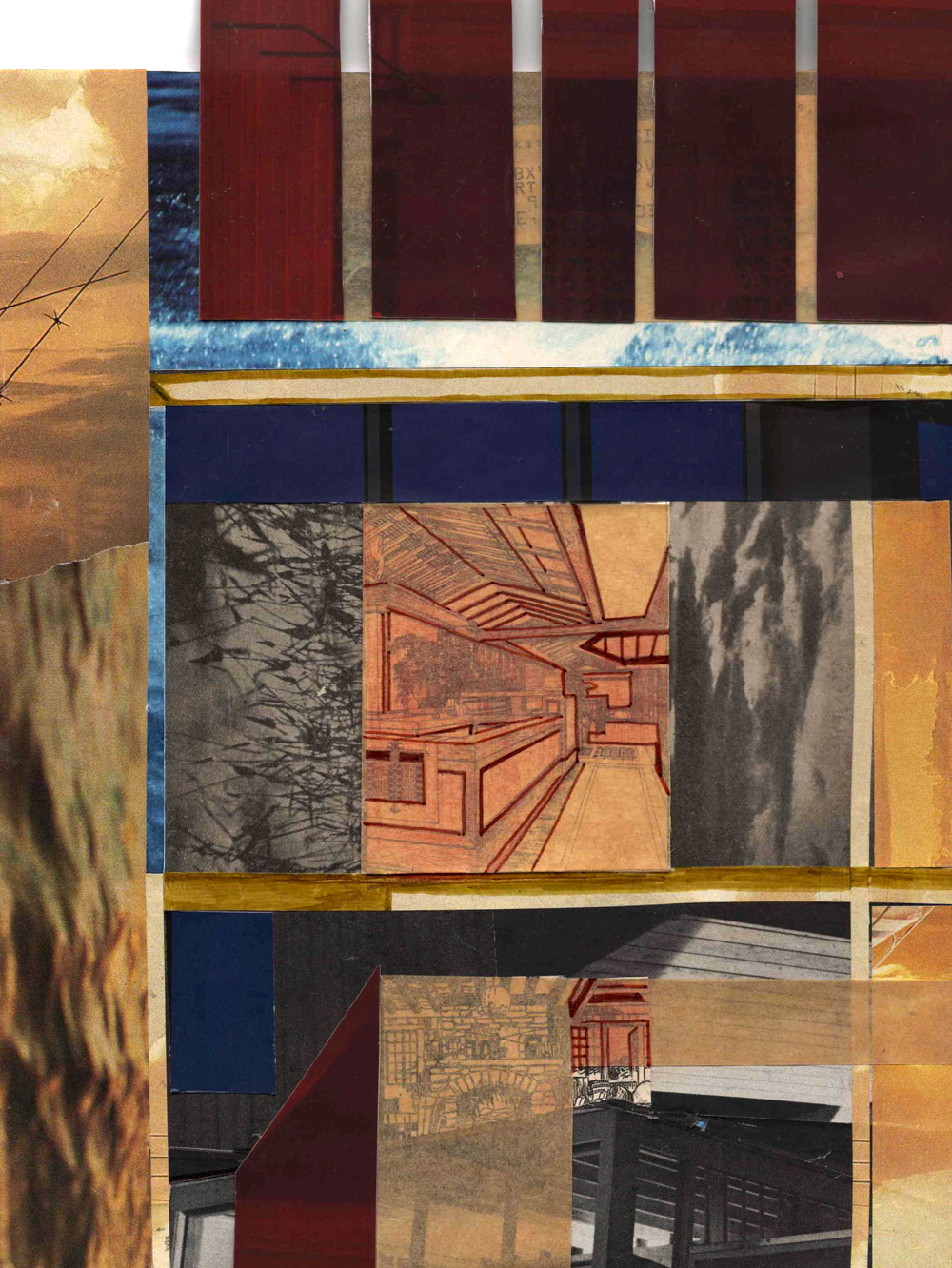
8.5″x12″; Field and Stream Magazine collage on canvas board. Courtesy of the artist.
SYMPOSIUM AT KOLAJ FEST NEW ORLEANS 2026
Architecture as Collage, Collage as Architecture
EVENT WEBSITE | REGISTER
Kolaj Fest New Orleans is a multi-day festival and symposium about contemporary collage and its role in art, culture, and society, 10-14 June 2026. Visit the website to learn more, see an overview of the program, and register to attend.
Symposium sessions at Kolaj Fest New Orleans bring together a group of artists who speak about a central theme. Artists, writers, academics, and curators present slideshows which are followed by a Question & Answer period.
Williams Research Center, 410 Chartres Street
Thursday, 11 June 2026, 3-4PM
Collage and modern architecture share a closely connected history. In the early twentieth century, as mass printing, photography, advertising, and illustrated magazines became increasingly accessible, artists and designers began cutting, combining, and recontextualizing printed images as a way to imagine new realities. At the same time, architects associated with modernism were embracing new materials, technologies, and spatial ideas, using photography, photomontage, drawing, and printed media to communicate buildings and material explorations. From avant-garde experiments in Europe to postwar design culture in the United States, collage and architecture careful curation became a tool for visualizing the modern world. New Orleans is a city that is an architectural collage in and of itself. Buildings from many different eras, cultures, and styles sit beside one another, forming the rich urban fabric that defines the city today. French, Spanish, Caribbean, Creole, Victorian, industrial, modern, and contemporary influences all overlap across New Orleans’ streetscapes, creating a built environment shaped by layering, adaptation, reuse, and memory. This panel is the beginning of a larger inquiry at Kolaj Institute into the relationship between Architecture & Collage
Based in New Orleans, West Michigan–born artist and curator Seth Ter Haar is the former Fellow of Docomomo US/Wisconsin, an architecture nonprofit dedicated to the documentation and conservation of the Modern Movement in Wisconsin. During this two-year fellowship, Ter Haar broadly studied 1920s–1980s Modernism across the state, specializing in research on the Layton School of Art, Wisconsin’s first art college, founded in the 1920s by a lesbian couple who introduced Bauhaus design principles to the region. He pays particular attention to queer legacies and their impact on architecture. In his artistic practice, Ter Haar extends these inquiries by using emerging technologies, including laser cutting and CNC machining, to reinterpret historical woodworking traditions through religious iconography. His work translates familiar faith-based imagery into queer frameworks of spiritual enlightenment, imagining a future in which queerness is directly intertwined with the literal architecture of daily life. On the panel, Ter Haar will introduce Kolaj Institute’s Architecture & Collage Project and share examples of buildings and artwork at the intersection of these disciplines.
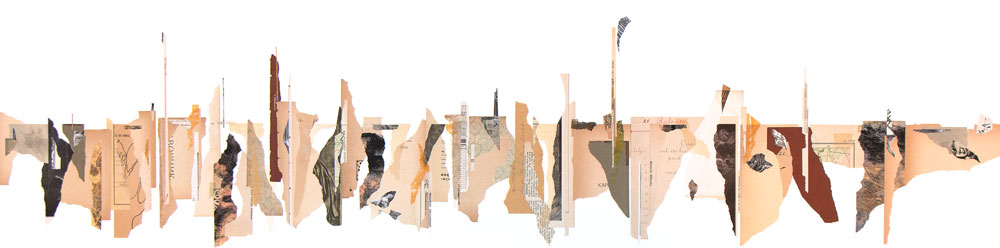
12″x48″; paper collage on wood panel; 2021. Courtesy of the artist.
Portland, Oregon artist and architect Clive Knights will speak about An Architecture of Experiential Encounter. He wrote, “Architectural design is dominated by linearity. Ideas are fed through the mill of orthographic description: plan, section, isometric. Even perspective is a linear construction of geometric rules despite purporting to be a viewpoint. With the advent of digital modelling most architecture students are now taught to dwell and create entirely inside the scale-free non-space coded by computer software, trapped in an infinite, isotropic realm devoid of body and feeling. As such, new architecture tends to be conceived as complex arrays of lineaments made of explicit dimensions and form with little regard at the stage of its inception for conditions pertaining to human experiential encounter. Yet it is our bodies that interpret the world at the level of phenomena, and which perceive the qualities of an environment sensorially. In my architectural pedagogy over four decades, collage has been an effective means of exploring possibilities for new architecture emerging from a focus directed first upon corporeal experience, on spatial qualities that affect the body: such as light and shade (chiaroscuro), material (tactility), depth (close-up, middle-ground, and distant), and scale (proportionate to the human body). This presentation will share and discuss various examples of collages created by me and my architecture students to redirect emphasis in architectural creativity toward experiential encounter.”
How does architecture and design impact community, identity, and belonging? Based in Lafayette, Louisiana, New Orleans-born artist and educator Michael Eble “creates colorful abstract works that merge collage, acrylic, and drawn elements to explore the evolving legacy of abstraction through modernist visual languages.” During a solo residency at the Kolaj Institute in New Orleans, Eble turned his focus toward the city’s mid-century architecture, particularly regional modernism—a design approach that adapts modernist principles such as simplicity, geometry, and functionality to specific cultural, environmental, and historical contexts. His research examined iconic structures including the International Rivergate Center and the Louisiana Superdome, landmarks of the postwar architectural boom that helped position New Orleans as an international city. Alongside these well-known sites, Eble documented lesser-known buildings from the era, tracing their formal qualities and cultural significance. Drawing inspiration from this research, Eble developed a new body of collages and large-scale paintings that layer geometric forms, textures, and color palettes evocative of mid-century design. Architectural motifs inform the shapes and compositions within the work, grounding abstraction in a strong sense of place. His process of building up and sanding through collage and painted surfaces mirrors both architectural construction and the gradual weathering of these structures over time.” On this panel, Eble will discuss his research and artwork and the process he uses to turn architecture into abstract collage.
Outreach Historian Robert Ticknor from the Williams Research Center at The Historic New Orleans Collection (HNOC) will preview examples of an architecture and collage project from the Historic New Orleans Collection. In 1978, to commemorate the opening of the new Manuscript Division at 722 Toulouse Street, HNOC shared Koch & Wilson’s architectural drawings of the building and invited people to collage on them. One hundred and twenty-two made their way back into the collection. “This brick Creole townhouse has been used as a rental property, apartment building, boardinghouse, furniture store, garage, and offices. Most notably, it housed Tennessee Williams’s first apartment—a garret space located in the attic of the two-story building,” wrote the organization. “HNOC restored the building in the late 1970s to match the 1852 drawing of the building. It housed the staff offices until HNOC closed the 533 Royal Street complex for renovations in 2023.” Kolaj Institute hopes to study this project and share its story as a late-20th century example of Collage as Art Movement.
ABOUT THE PRESENTERS
Portland, Oregon, USA. Clive Knights is an English collagist, printmaker and creator of festival structures. Since 2021, he has had solo shows of his collages and monotype prints in Portland, Oregon; Rome, Italy; and Williamsburg, Virginia. He has exhibited work in over 40 group shows in multiple US states and internationally, including “Amuse-Bouche” at LeMieux Galleries during Kolaj Fest New Orleans 2024 and 2025. In April 2022, he curated the international exhibition “Corporeal Gestures” in Portland. In June 2022, he published his first monograph, Gestures from a Body at Work: Unsuccessful Attempts at Grasping Eternity. In 2024 he collaborated with Canadian poet Terriann Walling to publish Labyrinth of Wind: Poems and Collages, which they presented at Kolaj Institute’s COLLAGE::BOOKS Symposium in Montreal in October 2025. The fine art publisher No Reply Press recently published two limited edition handmade books, The Ones Who Walk Away From Omelas by Ursula K Le Guin, accompanied by ten original collage interpretations; and The Death of Ivan Ilyich by Leo Tolstoy, accompanied by ten original monoprints. He was the founding director of the School of Architecture at Portland State University. Knights has presented at every Kolaj Fest New Orleans since 2018 and Kolaj LIVE Milwaukee. His fictional work, “The City of Objectivity”, appeared in Kolaj 30. His conversation with Andrea Burgay, “Excavations, Projections & Depth, Parts I & II” appeared in Kolaj 28 and 29. “Stranger at the Studio Table” appeared in Kolaj 17. His collage appears in Collage Artist Trading Cards, Pack Five. He is represented by Laura Vincent Design & Gallery in Portland, Oregon. Learn more at the Kolaj Magazine Artist Directory, www.cliveknights.com, and on Instagram @knightsclive.
Lafayette, Louisiana, USA. Michael Eble holds a BFA in painting from the University of Louisiana at Lafayette and an MFA in painting and drawing from the University of Mississippi. Eble is the Assistant Dean for the College of the Arts at the University of Louisiana at Lafayette. Before his return to Louisiana, he served as Associate Professor of Studio Art and Curator of the Edward J. & Helen Jean Morrison Gallery at the University of Minnesota, Morris. His works have been shown in solo and group shows across the US, including solo shows at the Hilliard Art Museum and the Acadiana Center for the Arts, and he is the recipient of many grants and awards. He is represented by Cole Pratt Gallery in New Orleans, which presented a solo show of his work in May 2026. He was a Kolaj Institute Solo Resident in May-June 2025 and was a panelist at Kolaj Fest New Orleans 2025. Originally from New Orleans, he now lives and works in Lafayette, Louisiana. Learn more at www.michaeleble.com and on Instagram @michaelebleartist.
New Orleans, Louisiana, USA. Robert Ticknor is the Outreach Historian for the Williams Research Center at The Historic New Orleans Collection, where he has worked since 2012. He holds a BA in History and Religious Studies from the College of Charleston and an MA in Medieval European History from Tulane University. He worked at the Stone Center for Latin American Studies at Tulane University. He also spent over a year as a Curatorial Assistant working for the Louisiana State Museum on their Colonial Documents Digitization Project before arriving permanently at The Historic New Orleans Collection. Learn about HNOC at www.hnoc.org.
New Orleans, Louisiana, USA. Seth Ter Haar is an artist, woodworker, curator, and self-proclaimed “fisher of men”, whose work explores the intersection of spirituality and contemporary gay culture. The 2024–2026 Fellow of Docomomo Wisconsin, Ter Haar studied modern art and architecture with particular attention to the queer femme–founded Layton School of Art and twentieth-century religious spaces across Wisconsin. His programming and research examined the ideologies behind making the sacred through postwar material experimentation and technical innovation, earning him the first-ever Student Documentation Award at Docomomo US’s Modernism in America Awards (2025). His work has been recognized through awards and fellowships, including the International Sculpture Center’s Outstanding Student Achievement in Contemporary Sculpture Award (2023), participation in the gener8tor Art x Sherman Phoenix grant program (2023), finalist status for Milwaukee’s Nohl Fellowship (2025) and an Open Fund Grant from The Andy Warhol Foundation for the Visual Arts’ (2025). Ter Haar is the Managing Director of Kolaj Institute. He has served as Gallery Director at the Milwaukee Artist Resource Network, preparator at the Haggerty Museum of Art, Jewish Museum Milwaukee and Tori Folliard Gallery and curated exhibitions for multiple organizations, including his alma mater the Milwaukee Institute of Art and Design. Learn more at www.sethterhaar.com.