
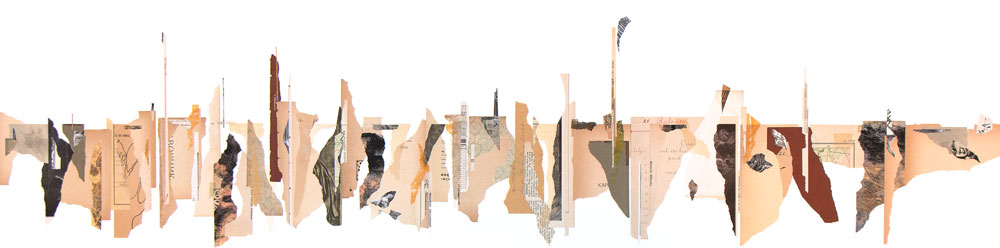
12″x48″; paper collage on wood panel; 2021. Courtesy of the artist.
SYMPOSIUM AT KOLAJ FEST NEW ORLEANS 2026
Autochthonous Cities, Anthropology, & Unfamiliarity: Collage Theory & Practice
EVENT WEBSITE | REGISTER
Kolaj Fest New Orleans is a multi-day festival and symposium about contemporary collage and its role in art, culture, and society, 10-14 June 2026. Visit the website to learn more, see an overview of the program, and register to attend.
Symposium sessions at Kolaj Fest New Orleans bring together a group of artists who speak about a central theme. Artists, writers, academics, and curators present slideshows which are followed by a Question & Answer period.
In this session, we will hear from three speakers, each with a unique take on collage theory and practice. Bucharest, Romania artist and educator Livia Marinescu will speak about her collage series, “The Third”, and the third space collage makes and her paper, “Between Unfamiliarity and Recognition: Collage as an Evocative Practice.” Durango, Colorado artist and professor Chad Colby will speak about the role of collage in his teaching and artist practices and a forthcoming chapter in Why Collage? Anthropology and Art in a Fragmented World (edited by Cathy Greenhalgh and Susan Falls) titled “Beyond Dada: Indigenous Reclamation through Contemporary American Collage.” Portland, Oregon collagist Clive Knights will speak about his series, “Autochthonous Cities,” as a reflection on the contemporary city. The collages are “the result of a kind of stewardship; intimations of newly born landscapes and settlements as they emerge from the detritus of print media produced by civil society.”
The Autochthonous Cities
The art critic John Berger observed, “We who draw do so not only to make something visible to others, but also to accompany something invisible to its incalculable destination.” Portland, Oregon collagist Clive Knights will speak about his series, “Autochthonous Cities,” as a reflection on the contemporary city. He wrote, “As the outcome of such acts of drawing, despite being comprised of a series of collages, the Autochthonous Cities are the offspring of a ‘drawing out’, a cultivation of sorts, a tillage of predominantly found materials that, in the spontaneity and hard graft of the art-making activity, coalesce their visual and semantic nutrients into new figurative outgrowths, rootings and sproutings, interments and dehiscences.”
“‘Autochthonous Cities’, a series of ongoing collage works that began to emerge in 2021, is the result of a kind of stewardship; intimations of newly born landscapes and settlements as they emerge from the detritus of print media produced by civil society. They are fictions, for sure, since the cities are only implied in the pushing and pulling of matter above and below the surface, that horizon, the edge between earth and atmosphere, soil and air, the chthonic and the celestial, where human life plays out. But, letting one’s imagination run free across the topography of each work, one will encounter the nascent evidence of transformation, the continuing duet of entropy and cultivation: building and dilapidating, constructing and excavating, piling and hollowing, towering and penetrating, reaching and nesting. They present, analogically, lands still in formation in which the vulnerabilities of the human species are revealed in the tentative structures fashioned from matter that purport to provide sanctuary for our fallible human actions within a formidable and transcendent kosmos.”
“The titles of the works reference deep etymological roots in the language human beings use to name their relationship with found terrain, in this case, since I am from England, the Old English terms that refer to land conditions and which have become embedded in thousands of place names, from the humblest homestead to the greatest cities, amidst the setting in which I was born and raised.”
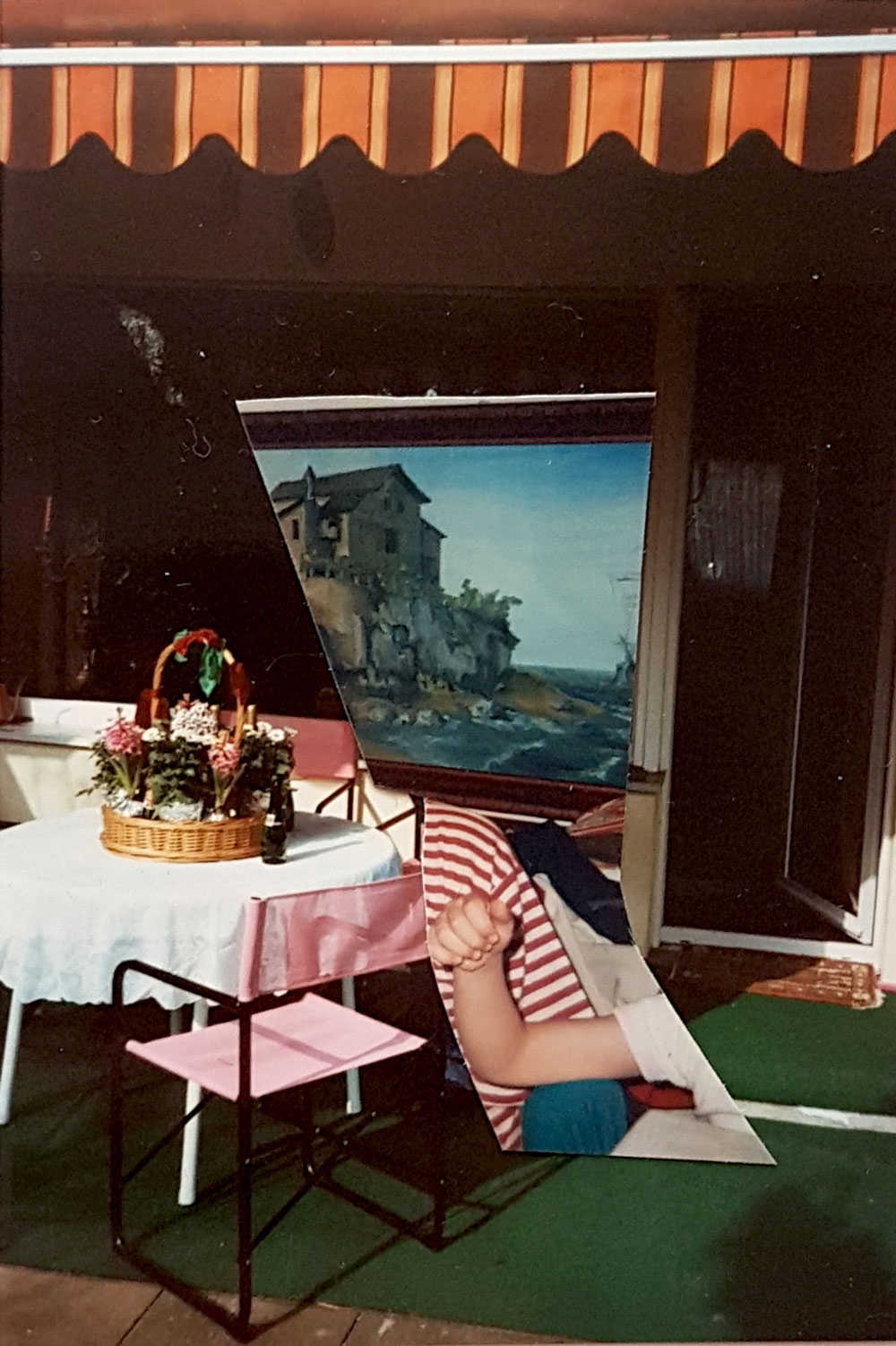
5″x3.5″; photograph/analogue collage; 2025-2026. Courtesy of the artist.
Between Unfamiliarity and Recognition: Collage as an Evocative Practice
How do you know when a collage is done? Each of the fourteen artworks in Bucharest, Romania artist and educator Livia Marinescu‘s series “The Third” is collaged using two vernacular photographs. “While creating the series, I became increasingly interested in the moment when a collage felt resolved: not because it appeared harmonious or complete, but because a particular fragment suddenly seemed to belong in a way no other fragment could, evoking an emotional space that, even without being named, appeared to transcend the private.” The artist wrote, “This shared recognition prompted me to reflect on the kind of perceptual space collage produces. Vernacular photographs, such as family snapshots, casual interiors, and everyday scenes, often lie dormant in albums and are typically consumed quickly. Their familiarity allows them to be read fluently and subsequently forgotten. By fragmenting and recombining them, collage interrupts that fluency. Based on this series, the paper proposes a distinction between descriptive and evocative collage. A descriptive image contains its meaning: it can be decoded and summarized. An evocative image, by contrast, resists that fixedness. It seeks to open a space to the viewer, inviting them to complete a perceptual and affective process that the image itself refuses to finalize. It operates in a space between the familiar and the unfamiliar, through a process of minimal intervention that produces an uncanny shift.” Marinescu will argue that collage makes a third space about which she wrote, “Situated between private memory and shared visual culture, this space allows recognition to occur without becoming fixed. Collage, when understood as an evocative practice, does not simply alter images, it reshapes the conditions under which meaning and memory are perceived.”
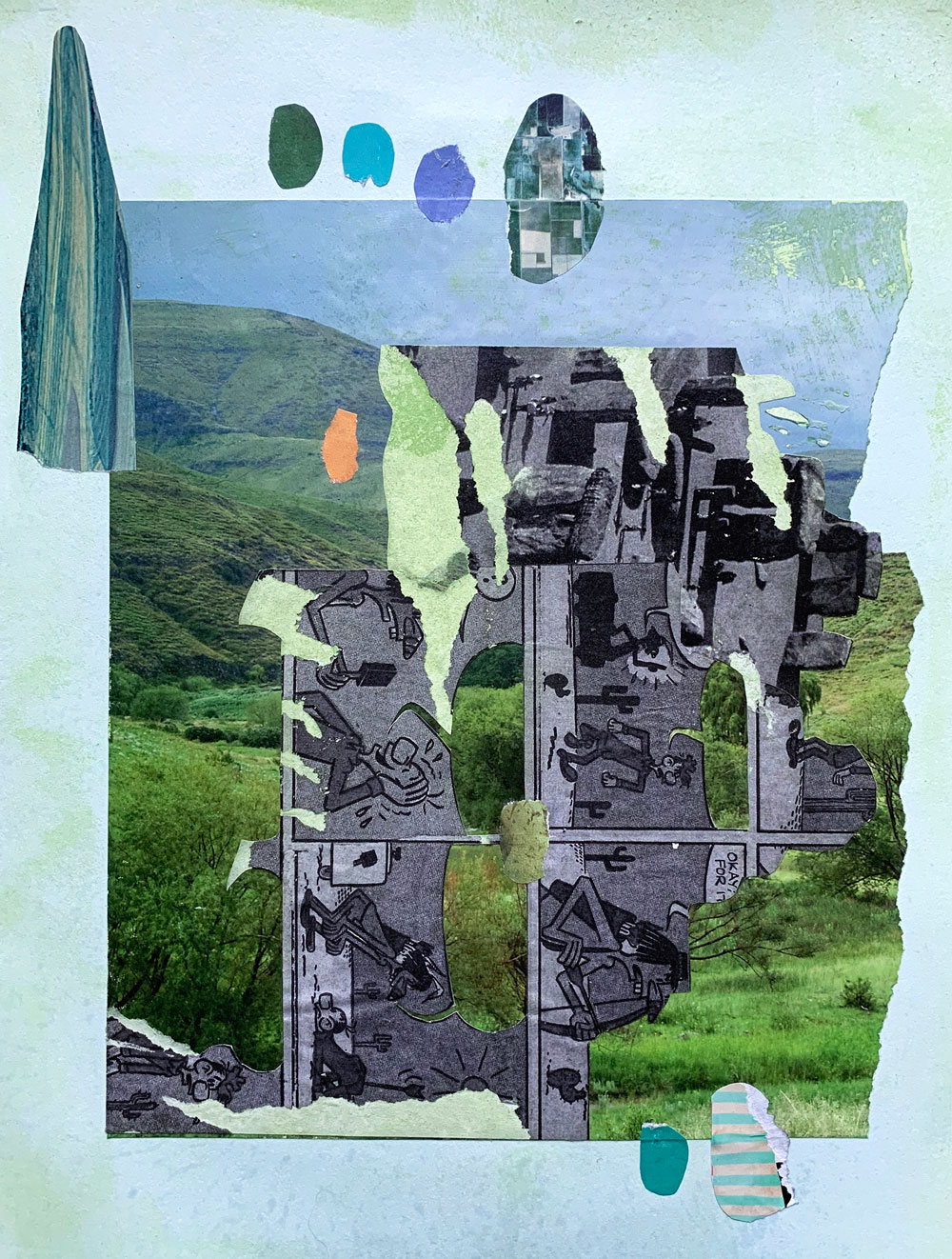
12″x10″; water-based paint, pencil, marker, and paper collage on heavyweight mixed-media paper; 2024. Courtesy of the artist.
Collage on a Continuum of Pedagogy Practice
How do we teach collage? How do we use collage in the classroom? Durango, Colorado artist and professor Chad Colby will speak about “role of collage as it applies to both my teaching and scholarly practice.” He wrote, collage “has had a significant influence on my pedagogy in studio arts. From painting to two-dimensional design, and multiple special topics courses investigating the intersection of collage, color theory, and mixed media, I’ve worked with students to explore the potential of this medium.” Colby’s essay, “Beyond Dada: Indigenous Reclamation through Contemporary American Collage,” considers how Native Americans have used collage and contributed to the medium. The essay was co-written with one of his former students at Fort Lewis College, collage artist Olivia Perea and will appear in the forthcoming publication, Why Collage? Anthropology and Art in a Fragmented World (edited by Cathy Greenhalgh and Susan Falls).
ABOUT THE PRESENTERS
Durango, Colorado, USA. Chad Colby holds a BFA in Painting from Indiana University and an MFA in Painting from The American University. He began his career in teaching at the Metropolitan State College of Denver (now Metropolitan State University.) He exhibited work at Carson-Masuoka Gallery and Studio Aiello, receiving critical acclaim that resulted in a 2002 Colorado Council on the Arts Fellowship. He is currently a Professor in the Department of Art & Design at Fort Lewis College in Durango, Colorado. His work has been shown in solo exhibitions in Colorado, New Mexico, and Oklahoma. In the fall of 2007, he was named Fort Lewis College’s Featured Scholar and in 2011 was awarded a full year sabbatical to pursue a creative project in western Mexico. Most recently, he was awarded a commission, along with teammates Hayley Kirkman and Lexis Loeb, as Colorado collaborating artists for Meow Wolf Denver’s convergence station. The artist lives with his family in Durango, where he maintains his studio. Learn more at www.chadwcolby.com.
Portland, Oregon, USA. Clive Knights is an English collagist, printmaker and creator of festival structures. Since 2021, he has had solo shows of his collages and monotype prints in Portland, Oregon; Rome, Italy; and Williamsburg, Virginia. He has exhibited work in over 40 group shows in multiple US states and internationally, including “Amuse-Bouche” at LeMieux Galleries during Kolaj Fest New Orleans 2024 and 2025. In April 2022, he curated the international exhibition “Corporeal Gestures” in Portland. In June 2022, he published his first monograph, Gestures from a Body at Work: Unsuccessful Attempts at Grasping Eternity. In 2024 he collaborated with Canadian poet Terriann Walling to publish Labyrinth of Wind: Poems and Collages, which they presented at Kolaj Institute’s COLLAGE::BOOKS Symposium in Montreal in October 2025. The fine art publisher No Reply Press recently published two limited edition handmade books, The Ones Who Walk Away from Omelas by Ursula K Le Guin, accompanied by ten original collage interpretations; and The Death of Ivan Ilyich by Leo Tolstoy, accompanied by ten original monoprints. He was the founding director of the School of Architecture at Portland State University. Knights has presented at every Kolaj Fest New Orleans since 2018 and Kolaj LIVE Milwaukee. His fictional work, “The City of Objectivity”, appeared in Kolaj 30. His conversation with Andrea Burgay, “Excavations, Projections & Depth, Parts I & II” appeared in Kolaj 28 and 29. “Stranger at the Studio Table” appeared in Kolaj 17. His collage appears in Collage Artist Trading Cards, Pack Five. He is represented by Laura Vincent Design & Gallery in Portland, Oregon. Learn more at the Kolaj Magazine Artist Directory, www.cliveknights.com, and on Instagram @knightsclive.
Bucharest, Romania. Livia Marinescu is a visual artist and educator, working across analogue collage, installation, and photography. She holds a degree in Art History from the University of St. Andrews and a degree in Psychology. She has shown her work at Kirkcaldy Galleries in Scotland and the Goethe-Institut and Palatul Bragadiru in Bucharest. She had a solo show at Art-An-Te Gallery in Bucharest. She has also worked as a curator, most recently for “Tangible Tomorrows” during Romanian Design Week 2025. Her collage and photography have been featured in Why Collage, Contemporary Collage Magazine, Suboart Magazine, and Stereoscope Magazine. She also develops and leads analogue collage workshops for festivals, cultural institutions, and corporate teams and has contributed to independent initiatives supporting the development of the collage scene in Bucharest, including exhibitions presented within the framework of Romanian Design Week, helping expand the visibility of collage within a broader contemporary cultural context. Learn more on Linktr.ee @liviamarinescu and on Instagram @thisisliviamarinescu.