
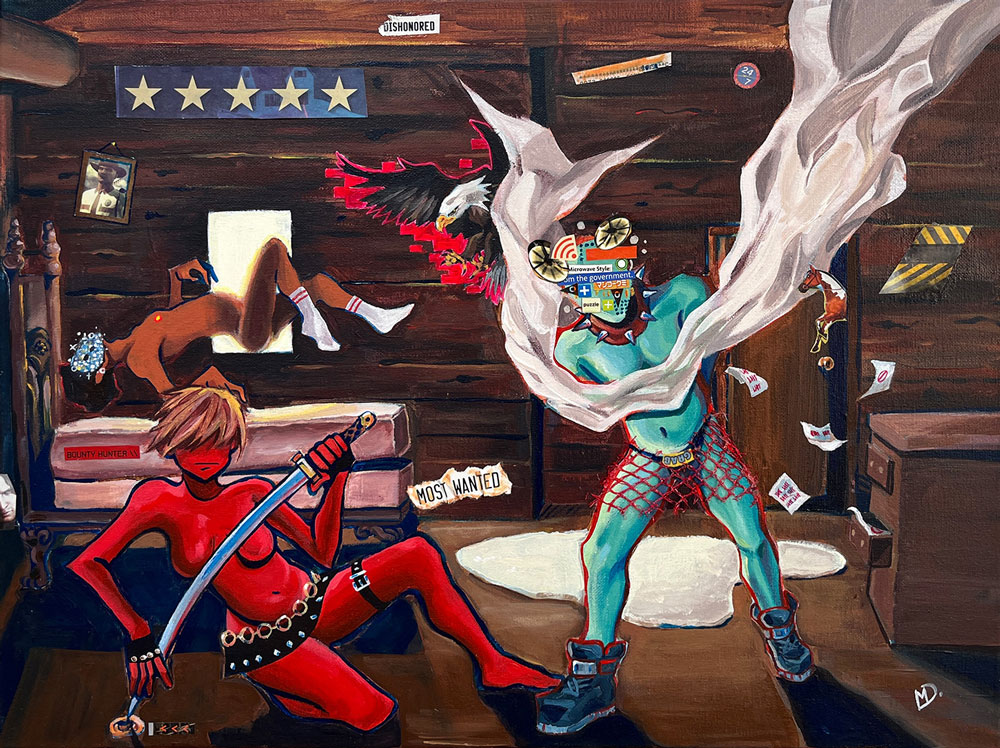
18″x24″, acrylic and mixed-media on canvas; 2024. Courtesy of the artist.
SYMPOSIUM AT KOLAJ FEST NEW ORLEANS 2026
Digital in the Real World
EVENT WEBSITE | REGISTER
Kolaj Fest New Orleans is a multi-day festival and symposium about contemporary collage and its role in art, culture, and society, 10-14 June 2026. Visit the website to learn more, see an overview of the program, and register to attend.
Symposium sessions at Kolaj Fest New Orleans bring together a group of artists who speak about a central theme. Artists, writers, academics, and curators present slideshows which are followed by a Question & Answer period.
Saturday, 13 June 2026, 2:15-3:15PM
Cafe Istanbul
Life in the 21st Century seems to exist in two places. Our bodies live in a physical, material world where we eat, sleep, and move about. Our minds are constantly drawn into a virtual world where we text and scroll; make connections and argue. Our civic, romantic, work, social, family, and creative selves exist in both of these places. To live in this time means to flow between corporeal and digital realities; it makes sense that artists are doing the same. On this panel, we will hear from four artists who bridge these worlds. Marques DeLoney is making analog art that responds to the digital age. T. Owens Union and Chris Miller are using digital tools to draw out social, cultural and historical narratives. Cody Roi will speak about using artificial intelligence to interpret artwork.
Selden, New York visual artist Marques DeLoney “uses collage to control the eye, pulling the viewer in and out of fiction or reality by combining painting and physical materials.” Re-contextualizing found material, he pushes the surreal aspect of his work further, creating a push-and-pull in and out of reality. On this panel, DeLoney will present his new series, “End of Expression” which he describes as “a commentary on the attack on personal identity and self expression in this new digital age. He wrote, “I explore themes of identity, self-expression and its suppression in western society, and the flattening of culture through social media. Through my art I want to create a space for challenging conversations, acknowledging the good, bad and ugly emotions we feel in day-to-day life. Not only should collaborators walk away with a sense of emotional validation, but also validation of their practice as mixed-media and collage artists.”
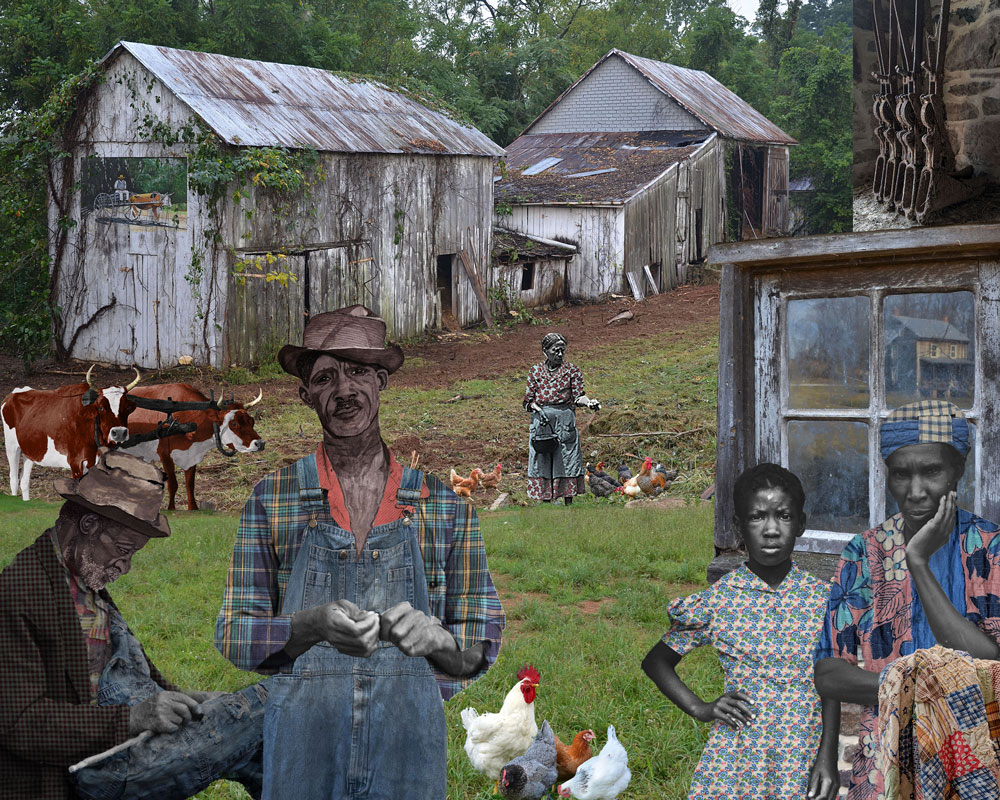
24″x30″; 1930s/1940s images of tenant farmers from the Library of Congress, photographs of barns, log cabin, found objects, drawing with graphite pencil/art markers, textiles, photography, Adobe Photoshop; 2026. Courtesy of the artist.
Fairfield, Pennsylvania artist T. Owens Union makes digital collage about African American culture and history. She digitally blends “historical materials that include text and images from historical documents, photographs of vintage dolls, African sculptures, and textiles, and found objects from our rural Pennsylvania farm property.” She wrote, “My grandmother from Tuscaloosa, Alabama made tied, patchwork quilts, and the quilt, a symbol of protection and guidance in our community, is often incorporated into the art.” On this panel, Owens Union will speak about her process and how she goes about making her work. By unpacking digital collage, she hopes to “remove some of the mystery and otherness.” Owens Union will also speak about how her work is about repairing the visual record of history. “The lack of a fully realized and accurate historical portrait of our community in American society has resulted in invisibility and inadequate representation.” The artist wrote, “My art utilizes documented African American experiences to give current representation to those whose freedoms were too often erased. Some artworks evidence the strength, pride, and perseverance of people of color despite what has been experienced over decades. Others were informed by historical events instituted and normalized by governmental agencies, medical institutions, and/or existing societal norms to exact marginalization and suppression.”
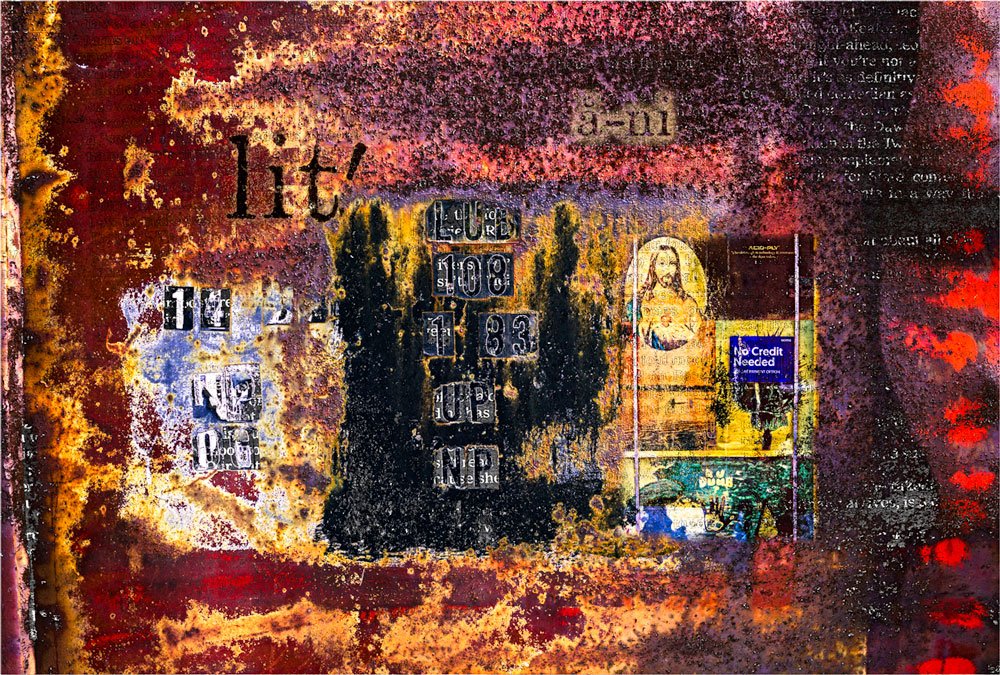
20″x26″; inkjet print; 2023. Courtesy of the artist.
How do artists develop narratives that speak to social or cultural narratives? How is that artwork received by the public? Ogden, Utah artist Chris Miller uses digital collage to transform “photographs into artistic workspaces for exploring the significance of reportorial or abstract elements identified by the artist, as symbols or metaphors for underlying social or cultural issues.” His recent work reflected on the nature of public discourse, spoke “to the decay and loss of historic and cultural resources”, and explored “the spirit, resolve, and creativity of dissenters.” While diffusing his work through local collaborative art and photography exhibits, he observed that “digital collage is artistically rewarding but can also be abstract and therefore confusing for viewers who expect more objective messaging in exhibits involving a combination of artists.” On this panel, Miller will share his experience exhibiting his work in “collaborative group exhibits that focus on public discourse, dissent, and community preservation” and speak about “the challenges of designing exhibits that include collage with other art forms” and public response to the collages. “My digital collages are often abstract to preserve artistic intent,” wrote Miller. “The abstraction can confuse viewers seeking more objective messages regarding social narrative, particularly when collages are presented next to fine art or journalistic photography.”
“We live in a time of relentless change. Collage, with its fragmented, layered, and intuitive nature, offers a uniquely suited medium for processing that change. Like a dream, collage can act as a bridge between the conscious and unconscious mind—surfacing symbols, associations, and emotional truths that resist verbal expression,” wrote New Orleans artist and clinical psychiatrist Cody Roi. “Yet because our internal experiences are often operating at the level of the unconscious, speaking through symbols, or blocked by fear and anxiety, we are often the least equipped people to objectively interpret our own inner world.” Is there a role for artificial intelligence (AI)? “AI tools capable of symbol recognition, cross-cultural analysis, and pattern detection offer a remarkable new lens through which to examine collage work. But this technology also brings real risks—including projection, reductive interpretation, and the stripping of personal meaning in favor of algorithmic generalization.” On this panel, Roi will share his experience using collage as a reflective and transitional practice across life stages and share collage examples with AI-generated interpretations, including surprising findings and moments of genuine resonance. He will speak about the risks of relying on AI and speak about who or what gets to define meaning.
ABOUT THE PRESENTERS
Ogden, Utah, USA. Chris Miller has worked in the field of natural resource and environmental management for more than 30 years. In his art practice, he originally concentrated on traditional black-and-white film and darkroom work, with training at the University of Michigan, the Smithsonian Institution, and a 2006 workshop with Bruce Barnbaum. His exploration of digital photography and collage started in 2012, while he was an officer and coordinator with the Wasatch Camera Club. Since 2010, he has participated in group shows around Ogden and received recognition through the Photographic Society of America and in statewide competitions at the Eccles Community Art Center. Learn more at www.substrateimage.com.
Selden, New York, USA. A native of Long Island, New York, multi-media visual artist Marques DeLoney holds a degree from the School of Visual Arts in New York City, where his academic portfolio was displayed in their online directory and at the Chelsea Gallery. He has shown his work in exhibitions in New York, Ohio, and Washington, including “Road to the Heart” (2024), a solo pop-up show in Manhattan showcasing over a dozen original works. Learn more at www.marquesdeloney.com and on Instagram @marques.deloney.
Fairfield, Pennsylvania, USA. T. Owens Union is a career scientist who holds an AAS degree in Fashion Marketing from Parsons School of Design (The New School). Since submitting artwork to juried competitions 2020, she has participated in multiple group exhibitions, resulting in 2nd place (Sulfur Studios, Savannah, Georgia), 3rd place (Pablo Center at the Confluence, Eau Claire, Wisconsin), and the Black Lives Matter award (FL3TCH3R Exhibit, Reese Museum, Johnson City, Tennessee). She was a presenter at Kolaj Fest New Orleans 2024 and her work was part of Kolaj Institute’s exhibition, “Temporal Geolocation: How Place & History Form Identity in Collage” (October-November 2024). Her first solo and international exhibition was at Gibsons Public Art Gallery in Gibsons, British Columbia, Canada in 2025, representing Black History Month. Learn more at www.owensunion.com.