
SYMPOSIUM AT KOLAJ FEST NEW ORLEANS 2026
Fragments & Formulations: The Art of Assembling a Child’s World
EVENT WEBSITE | REGISTER
Kolaj Fest New Orleans is a multi-day festival and symposium about contemporary collage and its role in art, culture, and society, 10-14 June 2026. Visit the website to learn more, see an overview of the program, and register to attend.
Symposium sessions at Kolaj Fest New Orleans bring together a group of artists who speak about a central theme. Artists, writers, academics, and curators present slideshows which are followed by a Question & Answer period.
Friday, 12 June 2026, 3:15-4PM
Cafe Istanbul
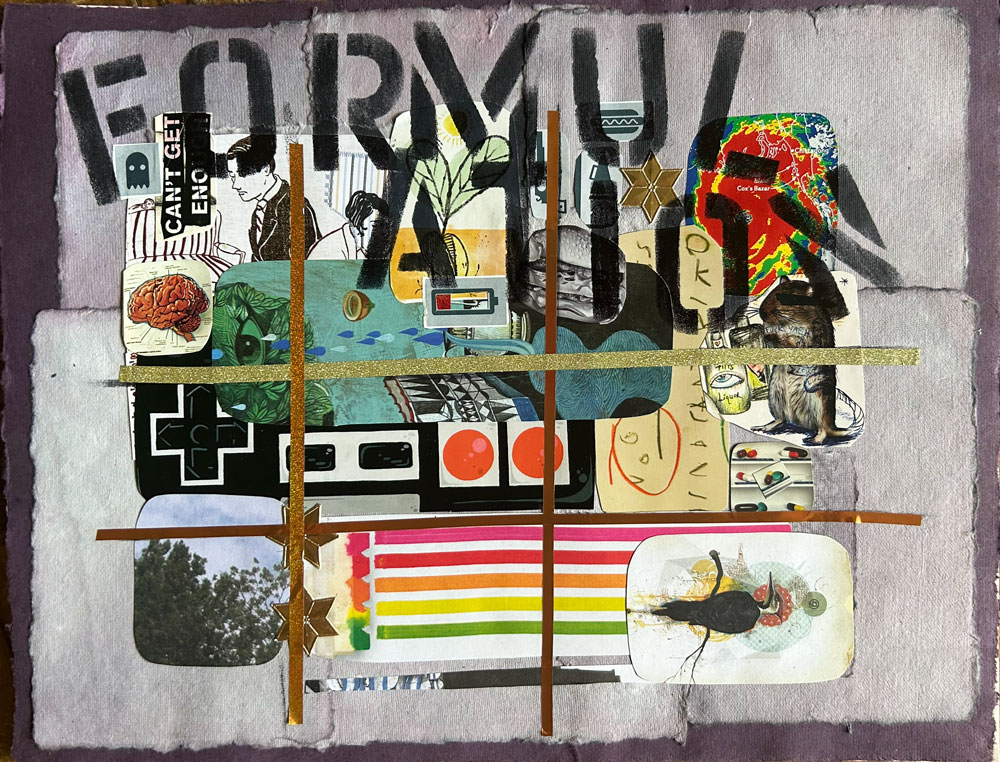
What role can collage play in medicine? On this panel, three child psychiatrists, Dr Nicole Crozat, Dr Hannah Scott, and Dr Cody Roi will share their experience using collage-based activities across three contexts: in their clinical work with children, as a medium to teach other physicians the complexities of working with family systems, and as a self-reflective process.
Child psychiatry occupies a singular position in medicine. Children are among our most vulnerable members, and the clinicians who care for them are, in a very real sense, on the front lines of humanity. The suffering that arrives in a child psychiatry clinic is rarely only individual—it is social, familial, and cultural. Children are the first place we see the cracks: the fractures in families, communities, and institutions that have not yet become visible elsewhere. The rise in adolescent anxiety and depression, the effects of poverty and racism on developing minds, the toll of collective trauma—these are not merely clinical phenomena. They are early signals of where humanity is heading, and child psychiatrists are among the first to receive them. That position demands more than diagnostic precision. It demands the capacity to hold complexity, to bear witness, and to understand suffering in its fullest human dimensions.
Child psychiatry sits at the intersection of science, narrative, and art. Case formulation—the clinician’s synthesis of a patient’s history, presentation, and context into a working explanatory model—is fundamentally a creative act, yet medical training rarely frames it as such. The result is a generation of clinicians who are skilled diagnosticians but underequipped to sit with ambiguity, hold multiple interpretations simultaneously, or draw on humanistic traditions to enrich their clinical thinking.
Collage offers a corrective. As an artistic practice rooted in fragmentation, juxtaposition, and the recontextualization of found material, collage demands exactly the cognitive and affective capacities that good clinical work requires: tolerance of incompleteness, attention to the unexpected connection, and willingness to revise. Bringing collage into medical education is not a matter of decoration or wellness programming—it is a pedagogical intervention aimed at the core of clinical reasoning.
The work has taken three distinct but related forms: as a structured case formulation exercise in which providers build collages representing a patient’s world; as a group reflective practice bringing provider teams together around shared clinical experiences; and as a component of a broader effort to integrate the humanities into psychiatric training. Together, these applications suggest that collage is a uniquely suited medium for the complexities of child mental health work.